
BYOMA Phyto-Mucin Glow Serum Review
The BYOMA Phyto-Mucin Glow Serum is one of those skincare products that managed to catch attention without being another ordinary hyaluronic acid serum. It takes inspiration from the popular snail mucin category but swaps snail secretion for a plant-based mucin complex while combining it with hyaluronic acid, panthenol, ceramide NP, cholesterol and peptides.
That sounds impressive on paper. But skincare marketing has a way of making every serum sound like it has discovered the fountain of youth.
The real question is whether the BYOMA Phyto-Mucin Glow Serum actually delivers noticeable hydration, glow and barrier support, or whether the viral attention is doing more work than the formula.
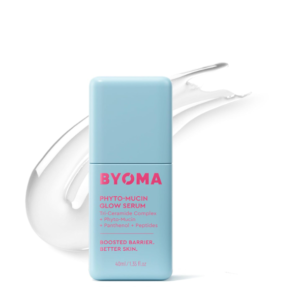
The serum is available through major beauty retailers and Amazon, with prices varying depending on the seller and promotions. The current BYOMA Phyto-Mucin Glow Serum listing on Amazon is one option for checking the current price and availability.
BYOMA Phyto-Mucin Glow Serum Ingredients
The ingredient list is actually where the BYOMA Phyto-Mucin Glow Serum becomes more interesting.
Rather than depending entirely on one trendy ingredient, the formula combines several humectants, plant extracts, skin-conditioning ingredients and barrier-supporting lipids.
According to the current Ulta ingredient listing for BYOMA Phyto-Mucin Glow Serum, the formula contains glycerin, butylene glycol, methylpropanediol, Japanese yam root extract, Laminaria japonica extract, okra fruit extract, palmitoyl tripeptide-1, panthenol, lotus root extract, polyglutamic acid, hyaluronic acid, hydrolyzed hyaluronic acid, sodium hyaluronate, ceramide NP, betaine, cholesterol and phytosphingosine, among other supporting ingredients.
That gives the serum a fairly strong hydration and barrier-support profile.
BYOMA Phyto-Mucin Glow Serum and Phyto-Mucin
The headline ingredient is phyto-mucin.
BYOMA positions this as a plant-based alternative to snail mucin. The formula includes extracts from plants such as Japanese yam, okra, jute leaf and lotus root.
The important distinction is that plant mucilage is not chemically identical to snail mucin. The comparison is primarily about the hydrating, cushioning and film-forming concept.
So anyone buying this because it is supposedly “plant snail mucin” should manage expectations. It is better described as a plant-derived mucilage-based hydration system rather than a literal botanical version of snail secretion.
BYOMA Phyto-Mucin Glow Serum and Hyaluronic Acid
The BYOMA Phyto-Mucin Glow Serum contains three forms of hyaluronic acid, including hyaluronic acid, hydrolyzed hyaluronic acid and sodium hyaluronate.
Hyaluronic acid is a well-established humectant used in topical skincare because of its ability to interact with water and improve skin hydration. A review published in Dermatologic Therapy examined the evidence surrounding topical hyaluronic acid and reported support for its hydration and skin-quality applications. The full scientific review is available through PubMed’s topical hyaluronic acid literature.
That makes the hydration claims of this serum more believable than some of the dramatic claims commonly attached to viral skincare products.
BYOMA Phyto-Mucin Glow Serum and Panthenol
Panthenol is another useful addition.
Also known as provitamin B5, panthenol functions primarily as a humectant and skin-conditioning ingredient. It fits the overall purpose of this formula because the serum is designed around hydration and barrier support rather than aggressive exfoliation.
This is one reason the product can make sense for skin that feels dry, tight or dehydrated.
BYOMA Phyto-Mucin Glow Serum and Ceramide NP
Ceramide NP may be one of the more meaningful ingredients in the formula from a barrier perspective.
Ceramides are naturally present in the outermost layer of the skin and work alongside cholesterol and fatty acids to help maintain the skin’s permeability barrier. A 2024 review indexed by PubMed on ceramides and skin barrier function explains the role of ceramides and related lipids in maintaining the skin barrier.
Another clinical literature review found that ceramide-containing topical preparations can improve dry skin and barrier function in certain populations. (PubMed)
The serum also contains cholesterol and phytosphingosine, which gives the barrier-support angle more substance than simply throwing the word “ceramide” onto the label.
BYOMA Phyto-Mucin Glow Serum Claims
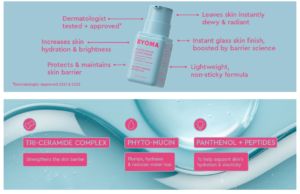
The BYOMA Phyto-Mucin Glow Serum is marketed as a multi-benefit serum that can hydrate, plump, brighten, prime and support the skin barrier.
The current BYOMA product information and ingredient listing describes the serum as dermatologist tested and alcohol and fragrance-free. The product is also marketed around barrier strengthening, hydration, plumping, elasticity and the appearance of fine lines.
There is an important distinction between the brand’s claims and what can reasonably be concluded from the ingredient list.
Hydration and temporary plumping are well aligned with the formula.
Barrier support is also plausible because the serum contains ceramide NP, cholesterol, phytosphingosine, panthenol and multiple humectants.
The wrinkle-reduction and elasticity claims require more caution. Those are product-specific outcomes and should not automatically be attributed to the presence of one peptide or hyaluronic acid.
BYOMA Phyto-Mucin Glow Serum Effectiveness
The BYOMA Phyto-Mucin Glow Serum appears better positioned as a hydration and skin-conditioning product than as an intensive treatment serum.
The immediate effect users are most likely to notice is increased hydration. When the outer layer of the skin holds more water, the surface can appear smoother, softer and temporarily more plump.
That can also make fine dehydration lines look less obvious.
The hyaluronic acid content supports this mechanism. Research examining topical hyaluronic acid has found potential benefits for hydration and aspects of visible skin aging, although results depend on formulation and study design. The published review on topical hyaluronic acid provides useful context here.
The ceramide and cholesterol combination adds another useful angle. The skin barrier relies heavily on ceramides, cholesterol and fatty acids, so including these types of lipids makes the product more than a basic water-attracting serum. (PubMed review)
Still, this is not a replacement for targeted treatments.
Someone dealing with persistent acne, melasma, stubborn hyperpigmentation or significant photoaging should not expect the BYOMA Phyto-Mucin Glow Serum to solve those problems on its own.
BYOMA Phyto-Mucin Glow Serum for Glass Skin
The glass-skin effect is probably one of the biggest reasons this serum gets attention.
Its combination of humectants, plant mucilage, polyglutamic acid and hyaluronic acid can leave the skin looking hydrated and reflective.
That effect is real, but it should not be confused with permanent skin transformation.
A hydrated skin surface naturally looks smoother and more luminous. The result can become particularly noticeable under makeup because well-hydrated skin tends to provide a smoother base.
Customer reviews on Ulta’s BYOMA Phyto-Mucin Glow Serum page include comments about hydration, glow and the lightweight, slightly gel-like texture.
BYOMA Phyto-Mucin Glow Serum Safety
The BYOMA Phyto-Mucin Glow Serum is marketed as fragrance-free and alcohol-free and is described by the retailer as dermatologist tested.
Its formula does not contain an obvious high-strength exfoliating acid or retinoid that would automatically make it a high-irritation treatment.
However, gentle does not mean reaction-proof.
The formula contains several botanical extracts, preservatives and multiple functional ingredients. Any of these can potentially cause irritation or sensitivity in an individual user.
The current retailer listing specifically identifies the product precaution as an eye irritant, meaning it should not be deliberately applied into the eyes. (Ulta)
A patch test remains sensible, particularly for sensitive or reactive skin.
BYOMA Phyto-Mucin Glow Serum for Acne-Prone Skin
The brand positions the BYOMA Phyto-Mucin Glow Serum as suitable for different skin types and lists it as non-comedogenic.
That is useful information, but it should not be interpreted as a guarantee that every acne-prone person will tolerate it.
Customer experiences are mixed enough to make this worth mentioning.
Some reviewers with oily and acne-prone skin report that the serum made their skin softer and more comfortable without causing problems. Other reviewers reported breakouts or dryness. The current Ulta review section provides the individual customer feedback behind those observations.
That contrast is exactly why individual tolerance matters with skincare.
A product can be technically non-comedogenic and still fail to agree with a particular person’s skin.
BYOMA Phyto-Mucin Glow Serum Customer Reviews
Customer feedback for the BYOMA Phyto-Mucin Glow Serum is generally favorable.
At the time of review, Ulta lists the product at 4.5 out of 5 stars from 328 reviews, with 93% of respondents saying they would recommend it to a friend. The rating distribution includes 227 five-star reviews, 60 four-star reviews, 26 three-star reviews, 7 two-star reviews and 8 one-star reviews. (Ulta customer reviews)
Positive reviews commonly mention:
- Hydrated skin
- A noticeable glow
- Softer skin
- A lightweight texture
- A plumping effect
- Easy layering under makeup
- A non-greasy finish
The negative feedback is smaller but still relevant.
Some users say the serum did not produce meaningful changes beyond hydration. Others reported breakouts or dryness.
This is a fairly normal pattern for skincare. A high average rating means the majority of reviewed users were satisfied. It does not mean the product will be universally compatible.
BYOMA Phyto-Mucin Glow Serum Texture
Texture is another strong part of the product’s appeal.
The serum has a lightweight, slightly gel-like consistency. It spreads easily and is intended to absorb without leaving a heavy or greasy finish.
The Ulta product page describes the formula and application instructions, while customer reviews repeatedly discuss the serum’s lightweight and hydrating feel.
The texture also makes sense for layering.
A serum that sits comfortably beneath moisturizer and sunscreen has more practical value than one that pills every time another product is applied.
That said, applying too much can make any humectant-heavy serum feel tacky. One pump is the amount recommended by the product instructions.
BYOMA Phyto-Mucin Glow Serum Under Makeup
The BYOMA Phyto-Mucin Glow Serum is particularly interesting for people who want hydrated-looking skin underneath makeup.
The product is positioned as a lightweight, primer-like serum, and customer reviews also mention using it underneath makeup.
This is one of the claims that fits the product particularly well.
Hydrated skin can provide a smoother surface, while the serum’s lightweight texture means it does not necessarily compete with foundation or primer.
The key is using a small amount and allowing the serum to settle before applying the next layer.
BYOMA Phyto-Mucin Glow Serum for Dry Skin
Dry and dehydrated skin may benefit the most from the formula.
Glycerin, several glycols, polyglutamic acid, betaine and multiple forms of hyaluronic acid provide several water-binding ingredients, while ceramide NP and cholesterol add barrier-supporting lipids.
The ingredient list can be checked directly through Ulta’s current BYOMA Phyto-Mucin Glow Serum listing.
This combination gives the product a stronger hydration profile than a serum that depends on hyaluronic acid alone.
However, extremely dry skin may still need a proper moisturizer on top.
A serum is not automatically a moisturizer simply because it contains hydrating ingredients.
BYOMA Phyto-Mucin Glow Serum for Oily and Combination Skin
Oily skin does not automatically mean hydrated skin.
Someone can have excess surface oil while still experiencing dehydration underneath. This is where a lightweight hydrating serum can make sense.
The BYOMA Phyto-Mucin Glow Serum does not have the heavy texture associated with many rich barrier creams, and the brand positions it as lightweight.
Still, oily skin that is highly congestion-prone should introduce the serum gradually rather than immediately combining it with several new products.
BYOMA Phyto-Mucin Glow Serum vs Snail Mucin
The BYOMA Phyto-Mucin Glow Serum is often compared with snail mucin products because of its mucin-inspired concept.
The two should not be treated as identical.
Snail mucin is an animal-derived secretion with its own complex mixture of components. BYOMA uses plant-derived extracts and builds the rest of the formula around conventional hydrating and barrier-support ingredients.
The more useful comparison is therefore not “Which mucin is better?”
It is whether the overall formula provides the hydration and skin-conditioning benefits expected from a mucin-style serum.
On that front, the BYOMA formula has several sensible supporting ingredients, particularly hyaluronic acid, panthenol, ceramide NP and cholesterol.
BYOMA Phyto-Mucin Glow Serum Pros and Cons
Pros
- Multiple hydrating ingredients
- Three listed forms of hyaluronic acid
- Contains panthenol
- Contains ceramide NP
- Contains cholesterol and phytosphingosine
- Includes palmitoyl tripeptide-1
- Lightweight texture
- Designed to layer under makeup
- Fragrance-free
- Alcohol-free
- Vegan positioning
- Strong overall customer rating
- Relatively affordable compared with many prestige serums
Cons
- Not a dedicated acne treatment
- Not a primary treatment for stubborn pigmentation
- The glass-skin effect is largely hydration-driven
- Individual users may experience breakouts or irritation
- Product-specific anti-aging claims should be interpreted cautiously
- Plant mucin should not be treated as chemically identical to snail mucin
BYOMA Phyto-Mucin Glow Serum How to Use
The BYOMA Phyto-Mucin Glow Serum is designed to be applied after cleansing.
The current product instructions recommend applying one pump to cleansed skin and gently patting until absorbed before continuing with the remaining skincare routine. (Ulta)
A simple routine could look like this.
Morning
Cleanser → BYOMA Phyto-Mucin Glow Serum → Moisturizer → Sunscreen
Evening
Cleanser → BYOMA Phyto-Mucin Glow Serum → Moisturizer
There is no need to drown the face in serum. More product does not automatically mean more hydration or better results.
BYOMA Phyto-Mucin Glow Serum Worth the Hype
The BYOMA Phyto-Mucin Glow Serum has a stronger formulation story than many viral skincare products.
The hype is understandable because the product combines several ingredients with legitimate roles in hydration and barrier support. Hyaluronic acid has evidence for improving skin hydration, while ceramides and related barrier lipids have established relevance to maintaining the skin’s protective function. (Topical hyaluronic acid research) (Ceramide research)
At the same time, the product should not be treated as a miracle serum.
The strongest case for it is hydration, plumping, softness, glow and barrier support.
The weaker case is using it as the main solution for acne, stubborn dark spots or advanced signs of photoaging.
The customer data also deserves attention. A 4.5-star rating from 328 Ulta reviews and a 93% recommendation rate indicate broadly positive user experiences, while the lower-rated reviews show that it is not universally perfect. (Ulta)
That combination makes the product easier to evaluate realistically.
BYOMA Phyto-Mucin Glow Serum Final Verdict
The BYOMA Phyto-Mucin Glow Serum looks less like a revolutionary skincare breakthrough and more like a well-designed hydration serum wrapped in a very marketable concept.
And that is not necessarily a bad thing.
Its ingredient list gives the product a legitimate foundation for hydration and barrier support. The combination of humectants, hyaluronic acid, panthenol, ceramide NP, cholesterol and phytosphingosine is more convincing than simply relying on the word “phyto-mucin” to sell the product.
The biggest strength is its ability to make skin look and feel more hydrated, smooth and plump without requiring a complicated routine.
The biggest limitation is that the product is sometimes discussed as though “glow” automatically equals correction of every major skin concern.
It does not.
For dry, dehydrated, dull or barrier-stressed skin, the BYOMA Phyto-Mucin Glow Serum is a reasonable product to consider.
For acne, stubborn hyperpigmentation or more aggressive anti-aging goals, a targeted active would still be necessary.
So, is the BYOMA Phyto-Mucin Glow Serum worth the hype?
The available formulation information, scientific background and customer feedback support the hydration and glow hype, but the more dramatic transformation claims deserve a little skepticism.
That makes it a potentially worthwhile everyday serum, rather than a miracle in a bottle.
BYOMA Phyto-Mucin Glow Serum Frequently Asked Questions
Is BYOMA Phyto-Mucin Glow Serum good for dry skin?
Yes. The BYOMA Phyto-Mucin Glow Serum contains glycerin, multiple forms of hyaluronic acid, polyglutamic acid, betaine and panthenol, alongside barrier-supporting lipids such as ceramide NP and cholesterol.
Is BYOMA Phyto-Mucin Glow Serum good for acne-prone skin?
The product is marketed as non-comedogenic and suitable for different skin types. However, customer experiences vary. Some acne-prone users report positive experiences, while others report breakouts or dryness. The Ulta customer review section is useful for seeing the range of experiences rather than relying solely on the average rating.
Does BYOMA Phyto-Mucin Glow Serum contain snail mucin?
No. The product uses plant-derived ingredients rather than snail secretion. It is designed around the concept of plant-based phyto-mucin.
Does BYOMA Phyto-Mucin Glow Serum contain vitamin C?
No. Vitamin C is not listed among the current ingredients for the Phyto-Mucin Glow Serum. The complete formula can be checked through the current Ulta ingredient listing.
Can BYOMA Phyto-Mucin Glow Serum be used under makeup?
Yes. The product is marketed as a lightweight, primer-like serum, and customer reviews include positive comments about using it underneath makeup.
Can BYOMA Phyto-Mucin Glow Serum reduce wrinkles?
The brand makes claims around fine lines and elasticity, but the formula should primarily be viewed as a hydrating and barrier-support serum. Better hydration can temporarily make fine dehydration lines appear less noticeable, but it should not be compared directly with dedicated retinoid-based anti-aging treatments.
Is BYOMA Phyto-Mucin Glow Serum fragrance-free?
Yes. The current product information describes it as fragrance-free and alcohol-free. (Ulta)
Is BYOMA Phyto-Mucin Glow Serum vegan?
BYOMA positions the product as vegan and plant-based in its product marketing.
How often should BYOMA Phyto-Mucin Glow Serum be used?
The product can be incorporated into a daily skincare routine. The listed instructions recommend one pump on cleansed skin before continuing with the rest of the routine.
Is BYOMA Phyto-Mucin Glow Serum worth buying?
For someone primarily looking for hydration, a plumper appearance, smoother texture and a dewy finish, the formula and customer feedback make it a reasonable option.
Those looking for a dedicated acne, pigmentation or intensive anti-aging treatment may need a more targeted product instead.