
EF ECOFLOW DELTA 3 Classic Review
Power stations have gone from being niche camping equipment to becoming a practical backup option for homes, remote workers, RV owners and anyone tired of watching a laptop battery die in the middle of an important task.
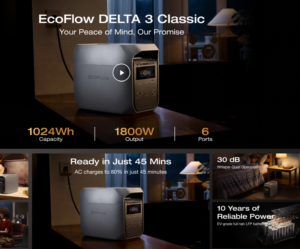
The EF ECOFLOW DELTA 3 Classic is positioned in that increasingly competitive space with a 1,024Wh LiFePO4 battery, 1,800W AC output, 3,600W surge capacity, fast charging and UPS functionality. The Amazon listing for the model reviewed here is ASIN B0FQVC4RF5.
On paper, the numbers look impressive. The more useful question is what those numbers mean when the unit is actually being used.
A 1,024Wh battery does not mean every appliance in a home can run all day. Likewise, an 1,800W inverter does not mean an 1,800W appliance can operate indefinitely. Battery capacity, appliance wattage, conversion losses and charging conditions all affect the real-world experience.
That distinction matters when considering whether the EF ECOFLOW DELTA 3 Classic is genuinely worth the attention it has received or whether some of the hype is simply coming from a long list of impressive specifications.
EF ECOFLOW DELTA 3 Classic Specifications
The EF ECOFLOW DELTA 3 Classic uses an LFP, or lithium iron phosphate, battery rated at 1,024Wh. The unit weighs approximately 12.1kg and measures about 398 × 200 × 283mm. It supports Wi-Fi and Bluetooth for smart control and monitoring.
The main specifications include
| Feature | EF ECOFLOW DELTA 3 Classic |
|---|---|
| Battery capacity | 1,024Wh |
| Battery chemistry | LiFePO4 / LFP |
| Continuous AC output | 1,800W |
| Surge output | 3,600W |
| X-Boost | Up to 2,600W depending on configuration |
| Solar input | Up to 500W |
| AC charging | Up to 1,400W on applicable versions |
| USB-C output | Up to 100W |
| USB-A output | Up to 18W |
| UPS switching | About 10ms |
| Weight | Approximately 12.1kg |
| Dimensions | Approximately 398 × 200 × 283mm |
| Connectivity | Wi-Fi and Bluetooth |
| Battery expansion | Not supported |
| Battery type | LFP |
| Operating temperature | -10°C to 45°C discharge |
| Charging temperature | 0°C to 45°C |
EcoFlow’s regional specifications should be checked before purchasing because outlet configuration and input voltage vary by market. The official documentation lists 120V versions for the US and 230V versions for several other regions.
For buyers in countries using 220-240V electricity, this regional difference is not a minor detail. The correct voltage version needs to be purchased rather than assuming every DELTA 3 Classic is electrically identical.
EF ECOFLOW DELTA 3 Classic Battery Capacity
The EF ECOFLOW DELTA 3 Classic has a 1,024Wh LFP battery.
That is enough to make this considerably more capable than the smaller power banks designed primarily for phones and tablets.
The actual runtime depends on the connected load. A low-power laptop and router combination will consume substantially less energy than an electric kettle, microwave, heater or hair dryer.
This is why watt-hours are more useful for estimating runtime than the headline inverter wattage.
For example, a 100W load theoretically consumes 100Wh every hour. A 1,000W load theoretically consumes 1,000Wh in one hour. Real-world runtime is lower because the inverter and other electronics consume some energy during operation.
Independent testing and analysis have estimated roughly 870Wh of usable AC energy after conversion losses on a 1,024Wh unit, although actual usable energy varies according to load and operating conditions.
That does not mean EcoFlow is falsely advertising the battery. The 1,024Wh figure refers to the rated energy stored in the battery cells. The difference comes from the normal losses involved in converting battery DC power into usable AC electricity.
EF ECOFLOW DELTA 3 Classic LiFePO4 Battery Claims
One of the more important claims surrounding the EF ECOFLOW DELTA 3 Classic concerns its LFP battery chemistry.
LiFePO4 batteries are generally valued for their durability, thermal characteristics and cycle life compared with many conventional lithium-ion chemistries.
EcoFlow markets the DELTA 3 Classic as providing up to 10 years of reliable power under its stated conditions and describes the battery cells as EV-grade full-tab LFP batteries.
That claim should still be interpreted properly.
A battery lasting “10 years” does not mean it will maintain exactly 100% of its original capacity for a decade. Battery degradation occurs gradually and depends on charging patterns, temperatures, depth of discharge, storage conditions and frequency of use.
The LFP chemistry is a legitimate advantage, but longevity claims should be viewed as manufacturer estimates rather than a guarantee of identical performance throughout the entire period.
EF ECOFLOW DELTA 3 Classic Power Output
The EF ECOFLOW DELTA 3 Classic provides 1,800W of continuous AC output and up to 3,600W of surge output according to EcoFlow’s specifications.
That gives it enough output for considerably more than basic electronics.
Depending on the appliance and regional model, users can potentially operate equipment such as
- Laptops
- Desktop computers
- Monitors
- Wi-Fi routers
- Televisions
- Lights
- Refrigerators
- Some microwaves
- Power tools
- Small kitchen appliances
The important word here is potentially.
An appliance being below 1,800W on paper does not automatically guarantee unlimited or trouble-free operation. Motors and compressors can draw significantly more power when starting, while heating appliances can drain a 1,024Wh battery very quickly.
The 3,600W surge rating is therefore useful for handling temporary startup demands, but it should not be confused with 3,600W of continuous output.
EF ECOFLOW DELTA 3 Classic X-Boost Claims
EcoFlow’s X-Boost feature is designed to allow the DELTA 3 Classic to operate certain appliances with power ratings above its standard output rating.
EcoFlow’s documentation lists X-Boost at up to 2,600W for the relevant model configuration.
X-Boost should not be interpreted as the power station suddenly having a larger battery.
Instead, it is a power-management feature intended to allow compatible high-wattage appliances to operate by adjusting the output characteristics.
This is useful for some appliances but should not be treated as a universal solution for every device rated above 1,800W.
Checking the appliance requirements before relying on X-Boost remains important.
EF ECOFLOW DELTA 3 Classic Fast Charging
Fast charging is one of the strongest claims attached to the EF ECOFLOW DELTA 3 Classic.
EcoFlow says the unit can reach 80% charge from AC power in approximately 45 minutes.
That means the station does not necessarily need to remain connected to the grid for several hours every time it is depleted.
This can be particularly useful during unpredictable outages.
A short period of electricity availability can restore a substantial amount of stored energy before the next outage.
The charging system is also one of the reasons the DELTA 3 Classic makes sense as an emergency backup rather than simply as a camping battery.
However, charging time can vary with the power source, temperature, settings and battery condition. The 45-minute figure should therefore be understood as a manufacturer’s specified performance condition rather than a universal promise for every charging situation.
EF ECOFLOW DELTA 3 Classic Solar Charging
The EF ECOFLOW DELTA 3 Classic supports up to 500W of solar input.
This allows the station to be paired with compatible solar panels for off-grid charging and emergency backup. EcoFlow’s documentation specifies a solar input range of 11-60V with a maximum input of 500W on the documented configuration.
This feature makes the DELTA 3 Classic more flexible than a conventional battery backup that depends entirely on grid electricity.
There is one catch.
The solar panels are not automatically included with every version of the product.
Buyers purchasing the bare power station will need to budget separately for compatible solar panels if solar charging is part of the plan.
Weather also matters. A 500W-rated solar input does not mean a 500W panel will continuously deliver 500W throughout the day.
Cloud cover, panel orientation, temperature, shading and sunlight intensity can all reduce actual production.
EF ECOFLOW DELTA 3 Classic UPS Performance
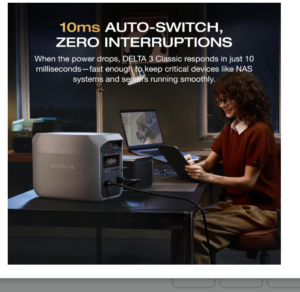
The EF ECOFLOW DELTA 3 Classic supports UPS functionality with a claimed transfer time of approximately 10 milliseconds.
This is particularly relevant for computers, networking equipment and other electronics that can be disrupted by a power interruption.
A fast transfer means the connected equipment has less time to notice the change between grid power and battery power.
That said, UPS performance should always be tested with the specific equipment being protected.
A power station is not automatically a perfect replacement for every dedicated enterprise-grade UPS simply because it has a fast transfer specification.
For ordinary home office equipment, however, this feature adds considerable usefulness.
EF ECOFLOW DELTA 3 Classic USB-C Output
The EF ECOFLOW DELTA 3 Classic includes a USB-C port capable of delivering up to 100W, along with a second USB-C output rated up to 30W on documented configurations. The USB-A output is rated up to 18W.
The 100W USB-C output is especially useful for compatible laptops.
Instead of converting battery power to AC and then allowing the laptop charger to convert it back to DC, compatible devices can draw power directly through USB-C.
That can reduce unnecessary conversion steps and make the power station more convenient for mobile work setups.
It also means the DELTA 3 Classic can function as something between a home backup system and an oversized charging hub.
EF ECOFLOW DELTA 3 Classic Port Selection
Port selection is one area where the EF ECOFLOW DELTA 3 Classic has some limitations.
The exact AC outlet configuration varies by regional model, while the documented unit includes USB-A and USB-C outputs. The model also does not provide the kind of extensive DC connectivity found on some competing power stations.
For a single user running a laptop, router, phone and monitor, this may not matter much.
For a family trying to charge multiple devices simultaneously, the limited port selection can become more noticeable.
This is one of those specifications that looks less exciting than 1,800W or 1,024Wh but can have a bigger impact on everyday convenience.
EF ECOFLOW DELTA 3 Classic Safety Features
Safety is a serious consideration with any large rechargeable lithium battery.
The EF ECOFLOW DELTA 3 Classic includes multiple protection systems, including over-voltage, overload, over-temperature, short-circuit, low-temperature, low-voltage and overcurrent protection.
The manufacturer also instructs users not to disassemble, modify or repair the unit themselves.
The official safety documentation advises keeping the power station away from water, excessive heat and direct sunlight and ensuring adequate ventilation during use and charging.
That matters because the DELTA 3 Classic is portable, but portable does not mean waterproof.
The safety manual specifically warns against exposure to water and liquids.
It should therefore be protected from rain, flooding, splashes and damp environments.
EF ECOFLOW DELTA 3 Classic Operating Temperature
The EF ECOFLOW DELTA 3 Classic has a specified charging temperature range of 0°C to 45°C and a discharge range of approximately -10°C to 45°C. EcoFlow identifies 20°C to 30°C as the optimal operating temperature range.
For users in hot climates, this deserves attention.
The power station should not be placed in a sealed car under intense sunlight or beside another major heat source simply because it is designed for outdoor use.
Good ventilation and sensible placement remain important for both safety and battery longevity.
EF ECOFLOW DELTA 3 Classic Portability
At approximately 12.1kg, the EF ECOFLOW DELTA 3 Classic is portable, but “portable” should not be confused with lightweight.
It is considerably heavier than a normal laptop power bank and is better suited to carrying between a room, vehicle, campsite or work area than hiking long distances with a backpack.
The weight is understandable given the 1,024Wh battery and 1,800W inverter.
There is always a trade-off between stored energy, output power and portability.
EF ECOFLOW DELTA 3 Classic Effectiveness
The effectiveness of the EF ECOFLOW DELTA 3 Classic depends heavily on the workload.
For laptops, routers, monitors, phones, lights and other moderate loads, the 1,024Wh battery can provide useful backup time.
For high-power heating appliances, the same battery can disappear much faster.
Independent testing has reported that the unit performs well as a mid-sized backup power station, with fast charging and relatively quiet operation standing out among its characteristics.
One reported real-world test from a customer using a computer at around 400W described approximately 2.5 hours of operation, while another customer reported running a 1.5-1.6kW air fryer successfully. These are individual experiences rather than guaranteed runtime figures, but they help demonstrate how strongly performance changes according to load.
That is the key takeaway.
The DELTA 3 Classic can deliver serious power, but serious power also consumes serious battery capacity.
EF ECOFLOW DELTA 3 Classic Customer Reviews
Customer feedback around the EF ECOFLOW DELTA 3 Classic is generally positive, although the experiences are not completely uniform.
A current EcoFlow France product page displays a verified customer rating of approximately 4.73 out of 5 across more than 1,800 reviews, with customers mentioning home backup, vans, refrigerators, computers and general power outages among their use cases.
Other retailer feedback also shows a 4.7 out of 5 customer rating, with most ratings concentrated around five stars.
Common positive themes include
- Fast charging
- Strong AC output
- Good battery capacity
- Quiet operation
- Easy setup
- Useful UPS functionality
- Reliable performance during outages
- Convenient app monitoring
Some customers have also praised the station for running computers and higher-powered kitchen appliances while remaining relatively quiet.
The more critical side of customer and independent feedback tends to focus on the missing 12V output, limited connectivity and the fact that the unit is not especially lightweight. Independent reviewers have also highlighted these trade-offs.
Customer reviews should still be treated as individual experiences rather than laboratory evidence. A five-star review from someone powering a router is not directly comparable with a review from someone attempting to run a refrigerator, microwave or power tool.
EF ECOFLOW DELTA 3 Classic Common Complaints
The EF ECOFLOW DELTA 3 Classic is not without compromises.
The first is battery expansion.
This model is not designed around expandable battery capacity, which means buyers who later discover that 1,024Wh is insufficient cannot simply add an expansion battery in the way they can with some larger EcoFlow models.
The second issue is connectivity.
Some competing units provide more extensive DC and vehicle-oriented outputs.
The third is portability.
At around 12.1kg, it is transportable but not exactly something to casually carry around all afternoon.
These limitations do not necessarily make the unit unsuitable. They simply make the intended market clearer.
The DELTA 3 Classic is better understood as a compact high-output backup station rather than an endlessly expandable home energy system.
EF ECOFLOW DELTA 3 Classic for Home Backup
For home backup, the EF ECOFLOW DELTA 3 Classic can cover a useful range of everyday electronics.
A practical setup could include
- Wi-Fi router
- Laptop
- Monitor
- Phone chargers
- LED lighting
- Television
- Decoder
- Small fan
- Selected low-to-moderate wattage appliances
The more power-hungry the appliance, the faster the battery will fall.
A refrigerator is also a special case because compressor startup can create a temporary power spike.
The 3,600W surge capability gives the unit useful headroom, but refrigerator runtime will still depend on the appliance’s efficiency, ambient temperature, compressor cycling and other factors.
EF ECOFLOW DELTA 3 Classic for Remote Work
Remote workers may find the EF ECOFLOW DELTA 3 Classic particularly practical.
A laptop, external monitor, router and phone can be kept running without relying on a noisy petrol generator.
The 100W USB-C output is another useful feature for compatible laptops.
The UPS function also adds another layer of convenience because the station can remain connected to the electrical supply and switch to battery power when the grid fails.
For anyone whose income depends on staying online, preventing an abrupt shutdown can be more valuable than simply having enough battery capacity for entertainment.
EF ECOFLOW DELTA 3 Classic for Camping and RV Use
The EF ECOFLOW DELTA 3 Classic is also marketed for camping and RV applications.
Its 1,024Wh capacity can support electronics, lights, refrigerators and selected appliances without requiring a petrol generator. EcoFlow lists camping, emergency backup and other portable applications among its intended uses.
The 500W solar input also gives outdoor users a way to replenish the battery without returning to the grid.
Still, anyone building an RV or off-grid setup should examine the port configuration carefully.
A model designed primarily around AC output may not be the best match for someone whose equipment is heavily dependent on 12V DC power.
EF ECOFLOW DELTA 3 Classic Noise Level
Noise is another area where the EF ECOFLOW DELTA 3 Classic appears to perform well.
EcoFlow advertises operation as low as approximately 30dB under load.
Independent reviewers have also described the station as relatively quiet, particularly at moderate loads.
That is useful for bedrooms, study spaces and overnight work.
Fan activity can increase as the power station handles heavier loads or charging demands, so “quiet” should not be interpreted as completely silent under every condition.
EF ECOFLOW DELTA 3 Classic App and Smart Features
The EF ECOFLOW DELTA 3 Classic supports Wi-Fi and Bluetooth connectivity.
This allows users to monitor and manage aspects of the power station through EcoFlow’s software ecosystem.
Smart monitoring is not necessarily the reason to buy a power station, but it becomes useful when the unit is being used as a semi-permanent backup system.
Being able to check battery levels and operating information without constantly walking over to the machine is a small convenience that can become surprisingly useful.
EF ECOFLOW DELTA 3 Classic Price and Value
The price of the EF ECOFLOW DELTA 3 Classic changes frequently depending on Amazon promotions, bundles and regional availability.
The exact Amazon listing supplied for this review is ASIN B0FQVC4RF5.
Because portable power station pricing can fluctuate considerably, comparing the current price against competing 1,000Wh-class LFP models is more useful than relying on an old advertised price.
The important thing is to compare like with like.
A cheaper unit with a slower charging system, smaller inverter or shorter warranty may not necessarily offer the same overall package.
Likewise, paying more for features that will never be used makes little sense.
EF ECOFLOW DELTA 3 Classic Pros and Cons
EF ECOFLOW DELTA 3 Classic Pros
- 1,024Wh LFP battery
- 1,800W continuous AC output
- 3,600W surge capability
- Fast AC charging
- Up to 500W solar input
- 100W USB-C output
- UPS functionality
- Wi-Fi and Bluetooth connectivity
- Relatively quiet operation
- Multiple battery protection systems
- Suitable for home backup, remote work and camping
EF ECOFLOW DELTA 3 Classic Cons
- Battery capacity is not expandable
- Approximately 12.1kg is substantial for portable use
- Solar panels may require a separate purchase
- Port selection may feel limited for larger households
- High-wattage appliances can drain the battery quickly
- Regional versions have different electrical specifications
- Not waterproof
- X-Boost should not be treated as a replacement for a higher-capacity inverter
EF ECOFLOW DELTA 3 Classic Is It Worth the Hype?
The EF ECOFLOW DELTA 3 Classic has enough substance behind its marketing claims to deserve serious consideration.
The 1,024Wh LFP battery is useful. The 1,800W output is genuinely substantial for a unit of this size. Fast AC charging is one of its strongest practical features, while the UPS capability makes it more useful for home offices than a basic camping battery.
The customer feedback also shows a broadly positive pattern, with verified EcoFlow reviews and retailer feedback highlighting backup performance, quiet operation, portability and ease of use.
But the product is not flawless.
The lack of expandable battery capacity limits its usefulness for people whose energy requirements may grow. The relatively limited port selection may also matter to users with several DC-powered devices.
There is another important reality.
A 1,024Wh power station is still a 1,024Wh power station.
It can run a 1,500W appliance, but that does not mean it will run that appliance for an entire day. High-power devices consume stored energy quickly.
For this reason, the EF ECOFLOW DELTA 3 Classic makes the most sense when the goal is reliable backup for essential electronics and moderate loads rather than trying to replace a complete household electricity system.
The hype is supported by real specifications and generally positive customer experiences, but the marketing becomes much easier to understand once the limitations are considered alongside the headline numbers.
EF ECOFLOW DELTA 3 Classic Buyer Checklist
Before buying the EF ECOFLOW DELTA 3 Classic, check the following
- Confirm the voltage version for your country
- Calculate the wattage of the appliances you actually intend to run
- Estimate how many hours of backup you need
- Check whether 1,024Wh is enough for your typical load
- Confirm whether you need 12V DC connectivity
- Decide whether you need expandable battery capacity
- Check whether solar charging is important
- Remember that solar panels may be sold separately
- Check the current Amazon price rather than an old advertised price
- Consider the 12.1kg weight before planning frequent transport
- Keep the unit away from rain, water and excessive heat
- Test UPS compatibility with important equipment before depending on it
- Compare the current price against similar 1kWh LFP power stations
EF ECOFLOW DELTA 3 Classic Frequently Asked Questions
What is the EF ECOFLOW DELTA 3 Classic battery capacity?
The EF ECOFLOW DELTA 3 Classic has a rated battery capacity of 1,024Wh and uses LiFePO4 battery chemistry.
How much power can the EF ECOFLOW DELTA 3 Classic provide?
The EF ECOFLOW DELTA 3 Classic provides up to 1,800W of continuous AC output and up to 3,600W of surge output according to EcoFlow’s specifications.
How fast does the EF ECOFLOW DELTA 3 Classic charge?
EcoFlow states that the EF ECOFLOW DELTA 3 Classic can reach 80% charge in approximately 45 minutes using AC charging under the specified conditions.
Does the EF ECOFLOW DELTA 3 Classic support solar charging?
Yes. The EF ECOFLOW DELTA 3 Classic supports up to 500W of solar input on the documented configuration.
Does the EF ECOFLOW DELTA 3 Classic have UPS functionality?
Yes. The EF ECOFLOW DELTA 3 Classic has a stated UPS transfer time of approximately 10 milliseconds.
Is the EF ECOFLOW DELTA 3 Classic waterproof?
No. The EF ECOFLOW DELTA 3 Classic should be protected from rain, water and other liquids. EcoFlow’s safety documentation specifically warns against exposing the unit to water or immersing it in liquid.
How heavy is the EF ECOFLOW DELTA 3 Classic?
The EF ECOFLOW DELTA 3 Classic weighs approximately 12.1kg or 26.6lb.
Can the EF ECOFLOW DELTA 3 Classic run a refrigerator?
It can potentially run a compatible refrigerator, provided the refrigerator’s starting and operating demands fall within the power station’s capabilities. Actual runtime depends on the refrigerator, ambient temperature, compressor cycling and other factors.
Does the EF ECOFLOW DELTA 3 Classic have a long-lasting battery?
The EF ECOFLOW DELTA 3 Classic uses LFP battery chemistry, which is designed for long service life. EcoFlow markets the battery as providing up to 10 years of reliable power under specified conditions.
Is the EF ECOFLOW DELTA 3 Classic good for laptops?
The EF ECOFLOW DELTA 3 Classic can be used to power laptops, including compatible USB-C laptops through its 100W USB-C output.
Does the EF ECOFLOW DELTA 3 Classic include solar panels?
Not necessarily. The bare power-station version and solar-panel bundles are different listings, so the contents should be checked carefully before ordering.
EF ECOFLOW DELTA 3 Classic Final Verdict
The EF ECOFLOW DELTA 3 Classic is a serious portable power station rather than an oversized phone charger.
Its 1,024Wh LFP battery, 1,800W AC output, fast charging, solar capability and UPS functionality give it a broad range of potential uses.
The strongest case for the product is not that it can power everything. It cannot.
The stronger case is that it can keep many of the things people actually need during an outage running without the noise, fuel and maintenance associated with a conventional generator.
Its limitations are equally clear. The battery is not expandable, the unit is fairly heavy, the port selection may not satisfy every setup and high-wattage appliances can consume its stored energy quickly.
For buyers who understand those trade-offs, the EF ECOFLOW DELTA 3 Classic looks like a well-rounded 1kWh-class power station with enough real-world capability behind its marketing to make the hype understandable.
Amazon listing: EF ECOFLOW DELTA 3 Classic on Amazon
Manufacturer specifications: EcoFlow DELTA 3 Classic specifications
Safety information: EcoFlow DELTA 3 Classic safety instructions