
FoodiePerk Review
FoodiePerk is currently attracting attention with a promotion that promises users a $250 Chipotle gift card after completing several online “deals.” On the surface, the offer appears simple. Visitors are encouraged to complete a number of promotional offers before they can supposedly unlock the advertised reward.
However, the process behind these reward offers deserves closer attention.
The important question is not simply whether FoodiePerk displays a $250 Chipotle gift card. The bigger question is what happens after a visitor clicks the claim button, completes the required deals, provides personal information, or reaches the supposed final stage of the reward process.
This FoodiePerk review examines the FoodiePerk $250 Chipotle gift card, the reward-claim process, possible scam risks, promotional tactics, personal-data concerns, and what users should know before attempting to claim the advertised reward.
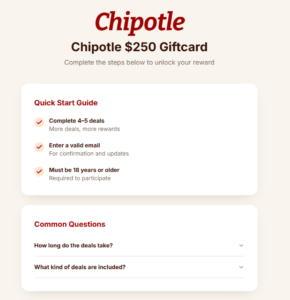
FoodiePerk Review of the $250 Chipotle Gift Card Offer
FoodiePerk promotes a $250 Chipotle gift card and tells visitors that they can unlock the reward by completing several online deals.
According to an investigation published by MalwareTips, the FoodiePerk promotion directs users into a third-party affiliate reward funnel rather than directly to Chipotle. The report also notes that the reward branding had previously appeared as an Olive Garden $750 gift card before changing to the current Chipotle promotion.
That change is worth paying attention to.
A legitimate promotional campaign can certainly change its prizes. However, when the same type of reward page repeatedly changes the featured brand while retaining a similar “complete deals to unlock your reward” structure, consumers should look at the underlying promotion rather than focusing only on the famous brand displayed on the page.
FoodiePerk is not Chipotle, and users should not confuse the FoodiePerk promotion with an official Chipotle gift-card promotion.
FoodiePerk Review of the Reward Claim Process
The biggest concern with this type of promotion is the difference between being told that you can win a gift card and actually receiving one.
The FoodiePerk offer reportedly instructs visitors to complete several deals before the reward becomes available. That can create a very different experience from what the initial advertisement suggests.
A visitor may initially think that completing a few simple tasks will result in a $250 gift card. After clicking through, however, the user may encounter additional promotional offers, subscriptions, surveys, app installations, trials, registrations, or other requirements.
This is where users need to slow down.
The promised reward can become the incentive that keeps the visitor moving through multiple third-party offers. Instead of simply claiming a gift card, the user may end up supplying an email address, phone number, demographic information, payment details, or other personal information to different advertisers.
The existence of an affiliate reward funnel does not automatically prove fraud. Affiliate marketing itself is a legitimate business model. The concern is whether the advertising gives users a clear and accurate understanding of what they must actually do to qualify for the reward.
FoodiePerk Review of the “Complete Deals” Requirement
The phrase “complete several deals” deserves particular attention.
A normal giveaway might ask a user to enter a competition, subscribe to an email list, or complete a simple eligibility form. A reward funnel requiring multiple unrelated offers is different.
The user may have to complete several promotions before the system considers the reward unlocked. Some offers may also have their own terms and conditions.
This creates several potential problems.
A user could complete one offer and discover that additional requirements remain.
Another user could sign up for a free trial and later forget to cancel it.
Someone else could provide payment information for an offer that automatically renews.
A user could also assume that completing the displayed offers guarantees the $250 reward when the actual terms contain additional eligibility conditions.
This is why consumers should read the terms of every individual offer instead of assuming that the headline tells the whole story.
FoodiePerk Review of Scams Related to Claiming Rewards
Reward scams often work by making the promised prize more attractive than the actual cost of obtaining it.
The cost does not always have to be direct payment.
Sometimes the real cost is personal information.
Sometimes it is time.
Sometimes it is subscribing to services.
Sometimes it is entering payment information for a trial.
Sometimes the user completes multiple promotional activities and still does not receive the expected reward.
The Federal Trade Commission warns consumers about prize scams where people are told they have won something but must pay money or provide something of value before receiving the supposed prize. The FTC specifically advises consumers to be cautious when a supposed prize requires payment or gift cards.
The FoodiePerk promotion is slightly different because the advertised requirement involves completing online deals rather than simply purchasing a gift card. Nevertheless, the same basic consumer-protection principle applies.
A promised reward should never be treated as guaranteed merely because an advertisement displays a large dollar amount.
FoodiePerk Review of Fake or Unreachable Rewards
One of the biggest risks with reward funnels is reaching the end of the process and discovering that the reward is still unavailable.
This can happen when users misunderstand the qualification requirements or when the promotion contains conditions that were not obvious from the initial advertisement.
In more problematic cases, consumers may repeatedly complete offers while being pushed toward additional requirements.
This creates a frustrating cycle.
Complete another deal.
Verify another offer.
Enter more information.
Complete another promotion.
Then discover another requirement.
At that point, the original $250 gift card may become less important than the amount of personal information, time, subscriptions, or money the user has already invested.
Consumers should therefore ask a simple question before starting.
What exactly qualifies me for the $250 reward, and where are the complete terms explaining when and how the reward will actually be delivered?
If that answer is difficult to find, caution is justified.
FoodiePerk Review of Personal Information Risks
Another issue surrounding reward promotions is data collection.
To complete online deals, users may be asked for information such as their name, email address, phone number, location, age, shopping preferences, or other demographic information.
Some offers may request even more information.
Providing information to one website can also lead to marketing communications from other companies involved in the promotional chain.
This does not necessarily mean that information is being stolen. Affiliate advertising and lead generation can involve legitimate data collection.
The problem is that many users do not fully understand how many companies may become involved after they start clicking through a reward funnel.
Before submitting personal information, users should read the privacy policy and terms of the website and individual offers.
FoodiePerk Review of Payment and Subscription Risks
The most important warning is to be extremely careful when a supposedly free reward requires entering payment information.
Some promotional offers advertise free trials or heavily discounted introductory periods. These offers can later become paid subscriptions if the user does not cancel within the stated period.
A user attempting to obtain a free $250 gift card could therefore end up paying for unrelated services.
This is one reason why consumers should record the name of every offer they complete, the date they sign up, the cancellation deadline, and whether the promotion automatically renews.
The FTC has repeatedly warned consumers about deceptive payment practices and recommends checking an offer independently rather than relying solely on the promotional message.
FoodiePerk Review of Chipotle Brand Association
The use of the Chipotle name is another factor worth considering.
A well-known restaurant brand naturally makes a promotion appear more familiar and credible. However, consumers should distinguish between a third-party website advertising a Chipotle gift card and an offer that actually originates from Chipotle.
FoodiePerk is not the official Chipotle website.
For this reason, anyone interested in Chipotle gift cards should verify promotions directly through Chipotle’s official website rather than assuming that every advertisement featuring the Chipotle name is connected to the company.
This distinction is important because scammers and aggressive marketers frequently use familiar brands to make unfamiliar promotions look more trustworthy.
FoodiePerk Review of Changing Gift Card Promotions
Another point raised in the available investigation is that FoodiePerk previously displayed an Olive Garden $750 gift card before the promotion changed to the $250 Chipotle gift card.
A changing reward does not by itself prove that a website is fraudulent.
However, it does raise a reasonable question about whether the restaurant brand is simply being used as the promotional hook.
If the reward changes from one major restaurant brand to another while the underlying process remains similar, consumers should evaluate the reward funnel itself.
The brand on the gift card should not be the deciding factor.
FoodiePerk Review of Affiliate Tracking
The reported redirection from the FoodiePerk claim process into a third-party affiliate funnel is also relevant. The investigation identified affiliate and offer-tracking parameters in the redirect.
Affiliate tracking is not automatically suspicious.
Many legitimate companies use affiliate tracking to determine which advertisement or publisher generated a customer.
The concern arises when users are not clearly informed that they are entering a marketing funnel involving third-party offers.
A consumer should understand whether they are entering a genuine giveaway, a lead-generation campaign, an affiliate promotion, or a combination of these.
FoodiePerk Review of Red Flags When Claiming the Reward
Several warning signs should make users reconsider continuing with the FoodiePerk reward process.
The first is a large reward that appears unusually easy to obtain.
The second is a requirement to complete multiple unrelated deals.
The third is being redirected away from the original website.
The fourth is being asked for extensive personal information.
The fifth is being asked for payment information for supposedly free offers.
The sixth is being presented with additional requirements after completing previous requirements.
The seventh is unclear information about exactly when and how the reward will be delivered.
None of these factors alone proves that FoodiePerk is fraudulent.
Taken together, however, they provide enough reason for consumers to proceed carefully.
FoodiePerk Review and the Difference Between a Scam and a Risky Promotion
It is important not to confuse an unpleasant or complicated reward promotion with a confirmed scam.
A promotion can be legitimate but still be poor value.
A website can operate an affiliate reward campaign while earning commissions from completed offers.
A user can technically qualify for a reward while still finding the process confusing or time-consuming.
On the other hand, a promotion becomes significantly more concerning if users are repeatedly asked to pay money, provide sensitive information, complete endless requirements, or never receive the promised reward.
For this reason, the most accurate description at this stage is to treat the FoodiePerk promotion as a high-risk reward funnel that deserves careful verification, rather than making an unsupported claim that the entire operation is definitively fraudulent.
FoodiePerk Review and What to Do Before Claiming the $250 Gift Card
Before completing any FoodiePerk deal, users should take a screenshot of the original offer.
Save the terms and conditions.
Record the exact reward being advertised.
Check whether the promotion identifies the company operating the giveaway.
Read the requirements for every individual deal.
Check whether any offer becomes a paid subscription.
Do not provide banking credentials or unnecessary sensitive information.
Do not purchase a gift card to supposedly unlock another gift card.
Do not pay a “processing fee,” “tax,” “verification fee,” or “delivery fee” simply because the website says the reward cannot otherwise be released.
The FTC specifically warns that demands for payment using gift cards are a major scam indicator.
FoodiePerk Review and What to Do If You Already Completed the Deals
If you have already entered the FoodiePerk promotion, do not panic.
First, identify every offer you completed.
Check your email for confirmation messages and subscription notices.
Review your bank or card statement for unexpected charges.
Cancel trials that you do not intend to keep.
Change passwords if you reused the same password across different websites.
If you supplied sensitive financial information and notice suspicious transactions, contact your financial institution immediately.
If you believe you were defrauded, report the incident to the appropriate consumer-protection authority. In the United States, consumers can report suspected fraud through ReportFraud.ftc.gov.
The FTC also recommends contacting the company that issued a gift card immediately if gift-card information has been given to a scammer.
FoodiePerk Review Verdict
The FoodiePerk $250 Chipotle gift card promotion deserves caution because the advertised reward is tied to completion of multiple online deals rather than being presented as a straightforward giveaway.
The reported use of a third-party affiliate reward funnel and the previous appearance of a different restaurant gift card also make it important to investigate the underlying promotion rather than relying on the Chipotle branding alone.
This does not, by itself, establish that FoodiePerk is a confirmed scam.
The bigger concern is the potential for users to spend time, disclose personal information, enter payment details, sign up for subscriptions, or complete multiple marketing offers while chasing a reward that may have additional conditions attached.
My advice is simple.
Do not treat the $250 Chipotle gift card as guaranteed. Read every offer carefully before completing it, avoid unnecessary payment information, and stop if the requirements keep expanding or the reward conditions remain unclear.
A $250 gift card is not worth turning your email inbox, bank statement, and personal information into collateral.
FoodiePerk Review Frequently Asked Questions
Is FoodiePerk offering a real $250 Chipotle gift card?
FoodiePerk is currently advertising a $250 Chipotle gift card. However, the reward is tied to completing several online deals, and the available investigation indicates that the claim process leads into a third-party affiliate reward funnel.
Is FoodiePerk an official Chipotle promotion?
No. FoodiePerk is a separate website and should not be confused with Chipotle’s official website or official promotional channels.
Is the FoodiePerk $250 Chipotle gift card a scam?
There is not enough evidence to state categorically that the entire FoodiePerk operation is a confirmed scam. However, the reward structure presents enough risk indicators that users should verify the terms carefully before completing any deals.
Why does FoodiePerk require users to complete deals?
The promotion appears to use a reward-based affiliate model where advertisers can generate revenue when users complete qualifying offers. The existence of affiliate marketing does not automatically make the promotion fraudulent, but users should understand what they are signing up for.
Can completing FoodiePerk deals lead to unwanted subscriptions?
It is possible when individual promotional offers involve free trials or recurring services. Users should carefully examine the terms of each offer before entering payment information.
Should I enter my card details to claim the FoodiePerk reward?
Extreme caution is recommended. If a supposedly free $250 gift card requires payment or a paid subscription, read the complete terms before proceeding. Never provide payment information simply because you are told that it is necessary to “unlock” a prize without understanding the charge.
Does completing the FoodiePerk deals guarantee the $250 gift card?
Users should not assume that completing the visible deals automatically guarantees delivery of the reward. The exact eligibility requirements, verification process, and delivery conditions should be checked before participating.
What should I do if FoodiePerk keeps asking me to complete more deals?
Stop and review the terms. If the requirements keep expanding or the final reward remains unclear, continuing may expose you to unnecessary marketing, subscriptions, or data collection.
What if I already provided my information to FoodiePerk?
Review your email, financial accounts, and subscriptions for unexpected activity. Cancel unwanted trials and contact your financial institution if you notice unauthorized charges.
Where can I report a suspected reward scam?
Consumers in the United States can report suspected fraud through ReportFraud.ftc.gov. The FTC also provides guidance on avoiding and reporting gift-card scams.
FoodiePerk Review Final Assessment
Overall assessment: Proceed with caution.
The $250 Chipotle gift card is an attractive headline, but the actual claim process matters more than the headline.
The requirement to complete several online deals, the reported redirection into a third-party affiliate funnel, and the changing gift-card branding are all reasons to investigate before participating.
Consumers should not assume that a famous restaurant name appearing on a reward page means the promotion is officially connected to that restaurant.
If the process requires excessive personal information, payment details, recurring subscriptions, or repeated additional offers, it is reasonable to stop.
The safest approach is to verify the promotion independently, read every condition, keep records of what you sign up for, and never pay a fee or provide gift-card details simply to receive a promised prize.