
Pest-Shield Tag Review. What Is Pest-Shield Tag?
Fleas and ticks can become a persistent problem for pet owners, particularly when conventional treatments require regular application or replacement. This has created demand for alternatives that promise long-lasting protection without adding another complicated step to a pet’s care routine.
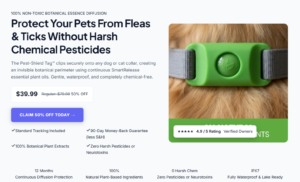
Pest-Shield Tag is a collar attachment marketed by RadPaws as a plant-oil-based flea and tick repellent for dogs and cats. The product is designed to attach to a pet’s existing collar and is advertised as releasing a blend of botanical oils over an extended period.
According to the manufacturer’s claims, the tag can help repel several pests, including fleas, ticks, lice and mosquitoes. It is also promoted as waterproof, refillable and capable of providing protection for up to 12 months.
These features may sound appealing, especially to pet owners looking for a convenient alternative to sprays, topical treatments or conventional flea collars.
However, there is an important distinction between a product’s advertised benefits and its independently demonstrated performance. A tag can be convenient to use without necessarily providing reliable protection against every pest listed in its marketing.
This Pest-Shield Tag review examines the advertised ingredients, safety considerations, effectiveness claims, customer feedback, pricing and refund conditions to determine whether the product offers genuine value.
The main question is whether the finished product has sufficient evidence behind its long-lasting protection claims to justify relying on it for a pet’s parasite prevention.
Pest-Shield Tag Claims. What Benefits Does the Manufacturer Advertise?
Pest-Shield Tag is promoted around several benefits intended to distinguish it from conventional flea and tick products.
Pest-Shield Tag Long-Lasting Protection Claim
The manufacturer advertises protection lasting up to 12 months. This is one of the product’s most attractive selling points because it suggests that pet owners may not need to replace the tag frequently.
However, a long-lasting protection claim requires more than evidence that the tag contains oils or gradually releases them. The manufacturer would need to demonstrate that the released formulation remains effective against the advertised pests throughout the stated period.
Independent testing establishing that full duration was not identified in the materials reviewed.
Pest-Shield Tag Plant-Oil Formula Claim
The product is marketed as using botanical ingredients rather than relying on the same approach as some conventional parasite-control products.
Although plant-derived substances can have insect-repellent properties, their presence does not automatically establish that a finished product is effective, non-toxic or appropriate for every pet.
The formulation, concentration, exposure level and intended use all matter.
Pest-Shield Tag Multi-Pest Protection Claim
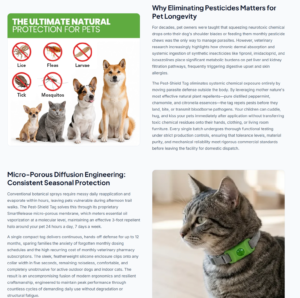
The tag is advertised for use against fleas, ticks, lice, larvae and mosquitoes.
Each pest presents different biological and testing requirements. Evidence that a formulation repels mosquitoes, for example, would not automatically prove that it prevents ticks from attaching to an animal.
The available information does not sufficiently establish independent testing of the finished tag against every advertised pest.
Pest-Shield Tag Waterproof and Refillable Claims
The manufacturer also promotes the tag as waterproof and refillable.
These features may improve convenience, but they do not independently establish parasite protection. The waterproof claim would ideally be supported by testing after repeated exposure to water, while the refillable design should be accompanied by clear information about replacement ingredients, costs and instructions.
The product’s advertised features are worth considering, but effectiveness remains the most important factor when the intended purpose is parasite prevention.
Pest-Shield Tag Ingredients. What Does the Formula Contain?
According to the product information attributed to RadPaws, Pest-Shield Tag contains peppermint oil, citronella oil and chamomile oil.
The available materials do not provide a sufficiently detailed concentration breakdown to establish exactly how much of each ingredient is present or how the complete formulation behaves during prolonged use.
Pest-Shield Tag Peppermint Oil
Peppermint oil is used in various botanical products, including some formulations marketed for insect repellency.
Its potential effectiveness depends on the concentration, formulation, exposure conditions and target pest. The presence of peppermint oil in a collar attachment does not prove that the product will reliably repel fleas and ticks for an entire year.
The precise concentration and release rate of peppermint oil in Pest-Shield Tag were not independently established in the materials reviewed.
Pest-Shield Tag Citronella Oil
Citronella oil is commonly associated with insect-repellent products.
However, the effectiveness of citronella depends on how it is formulated and used. Evidence concerning citronella in one product cannot automatically be transferred to a different formulation or delivery mechanism.
The US Environmental Protection Agency’s guidance on insect repellents provides useful background on repellent products and the importance of evaluating the claims associated with their intended use.
Pest-Shield Tag Chamomile Oil
Chamomile oil is the third ingredient named in the manufacturer’s product description.
The available information does not adequately explain its concentration, its specific contribution to pest repellency or how it interacts with the other oils in the finished tag.
Without more detailed formulation information, its precise role in the product cannot be established.
Pest-Shield Tag Ingredient Transparency
The three named oils provide some insight into the advertised formulation, but the information remains incomplete for a thorough assessment of product performance and safety.
The materials reviewed did not establish the precise concentration of each oil, the full formulation or independent testing of the finished product.
For a product intended to remain attached to an animal for an extended period, clear ingredient labelling, appropriate directions, species-specific precautions and supporting safety information are essential.
Pest-Shield Tag Safety. Is It Safe for Dogs and Cats?
Safety is one of the most important considerations when evaluating a product that remains attached to a pet for weeks or months.
Pest-Shield Tag is marketed as a plant-oil-based alternative to conventional parasite prevention. However, natural ingredients are not automatically harmless, and the absence of a conventional pesticide does not guarantee that a product is safe for every animal.
Essential oils can cause adverse effects depending on the substance, concentration, exposure route and animal involved. Dogs and cats can also respond differently to particular compounds.
Cats deserve particular caution because they can be sensitive to certain essential oils and may be exposed through grooming or accidental contact with leaked ingredients.
The materials reviewed did not establish a comprehensive independent safety assessment of the finished Pest-Shield Tag for all the animals it is marketed for.
Before using the product, pet owners should verify the following.
- The complete ingredient list and any available concentration information.
- Whether the exact product is labelled for the animal’s species and age.
- The manufacturer’s instructions for use, warnings and accidental exposure.
- Whether it is appropriate for pets already receiving other parasite-prevention treatments.
- Whether a veterinarian recommends its use for the particular animal.
If a pet develops unusual symptoms after exposure, remove the tag if it is safe to do so and contact a veterinarian promptly.
For additional information, consult the US EPA’s guidance on pesticide products used on pets.
The available evidence does not justify declaring Pest-Shield Tag inherently unsafe. Equally, it does not support a blanket assurance that it is safe for every dog or cat.
Pest-Shield Tag Effectiveness. Does It Really Work?
This is where the product requires the closest scrutiny.
The manufacturer claims that Pest-Shield Tag gradually releases plant oils to repel pests. Such a delivery mechanism is plausible in principle, but the existence of a plausible mechanism is not proof that the finished product delivers reliable results.
To demonstrate effectiveness, testing would need to identify the target pests, establish the conditions under which the tag works, measure its performance and determine how long effective protection continues.
The materials reviewed did not establish those points through sufficient independent testing of the finished product.
Pest-Shield Tag Flea Protection
The tag is marketed as a repellent designed to discourage fleas from approaching or remaining on a pet.
Repelling new pests, however, is not the same as eliminating an existing infestation.
Fleas can live in carpets, bedding and other parts of the home, where eggs and immature stages may continue developing. Attaching a tag to an animal should not be assumed to eliminate an established infestation.
Pet owners dealing with fleas should seek appropriate treatment advice and consider environmental control measures.
Pest-Shield Tag Tick Protection
Ticks are another major target of the product’s marketing.
Reliable tick prevention matters because ticks can attach to animals and potentially transmit disease. A product intended to reduce this risk should have evidence demonstrating its effectiveness against relevant tick species.
Independent finished-product testing confirming Pest-Shield Tag’s tick-repellent performance was not identified in the materials reviewed.
Until that evidence is available, the tag should not be assumed to offer protection equivalent to an established veterinary-recommended product.
Pest-Shield Tag and the 12-Month Protection Claim
A tag that continues releasing an ingredient for 12 months does not necessarily provide effective pest repellency for 12 months.
The concentration released may change over time, and environmental conditions may influence performance. The important question is whether the product continues to repel the target pests at an effective level throughout the advertised period.
The manufacturer’s 12-month claim was not independently verified in the available materials.
Consequently, buyers should treat this duration as an advertised estimate rather than a scientifically established guarantee.
Pest-Shield Tag and the Three-Times-More-Effective Claim
Product coverage published in 2026 reports that the seller advertises the tag as up to three times more effective than chemical collars.
However, the coverage did not identify an independent comparative study or sufficient methodology supporting that figure.
A claim of superior effectiveness should identify what products were compared, which pests were tested, the study conditions and the measured outcomes.
Without that information, the comparison remains a marketing claim rather than an independently established result.
Pest-Shield Tag Customer Reviews. What Are Buyers Saying?
Customer reviews can help prospective buyers understand how a product is received, but they should be interpreted alongside evidence of effectiveness and safety.
According to Access Newswire’s Pest-Shield Tag review coverage, the brand’s sales page displayed a rating of approximately 4.8 out of 5 based on more than 12,000 reviews.
These figures were reported as displayed by the brand. The review platform and verification method were not independently established in that coverage.
That distinction matters because a rating displayed on a seller’s website is not necessarily an independently audited measure of customer satisfaction or product effectiveness.
Pest-Shield Tag Positive Customer Feedback
The seller’s product page highlights positive customer testimonials and favourable ratings.
Such feedback may indicate that some buyers appreciate the product’s convenience, collar attachment or perceived reduction in pests.
However, a customer reporting fewer fleas does not establish that the tag caused the reduction. Other factors, including environmental changes, existing treatments and seasonal differences, may influence the outcome.
Positive feedback is useful as an indication of customer experience, but it cannot replace controlled testing.
Pest-Shield Tag Negative Reviews and Complaints
The materials reviewed did not establish a sufficiently reliable, independent collection of negative reviews specific to this exact product to determine a consistent pattern of failure.
It would therefore be misleading to claim that all buyers are dissatisfied or that widespread product failure has been conclusively demonstrated.
The more defensible concern is that the available customer feedback does not resolve the main scientific questions about effectiveness, safety and the advertised protection period.
Pest-Shield Tag Review Reliability
Customer feedback is most useful when it comes from identifiable, verified purchasers and includes enough detail to assess the experience.
Before placing an order, check whether the review platform is independent, whether negative feedback is visible and whether reviewers identify the exact product purchased.
Also distinguish between reviews of Pest-Shield Tag and feedback about similarly named pest-control products. Similar names do not necessarily mean the products have the same formulation, manufacturer or performance.
The reported 4.8 rating should therefore be treated as a brand-displayed score, not as proof that the tag provides reliable parasite prevention.
Pest-Shield Tag Price. How Much Does It Cost?
Product coverage published in 2026 reported the following prices for Pest-Shield Tag.
| Package | Reported price per tag | Reported package total |
|---|---|---|
| One tag | $39.99 | $39.99 |
| Two tags | $35.99 | $71.98 |
| Three tags | $31.99 | $95.97 |
| Four tags | $27.99 | $111.96 |
| Five tags | $23.99 | $119.95 |
These figures are reported advertised prices and may change. Shipping, taxes, currency conversion and promotional offers may affect the final checkout total.
The seller also advertises package discounts. However, the reference prices used to calculate those discounts were not independently verified against a historical price record.
For buyers outside the United States, including Nigeria, international shipping and currency-conversion charges may increase the final cost.
The key consideration is whether the product’s demonstrated performance justifies its price. A lower price per tag does not necessarily represent good value when the effectiveness of the product remains uncertain.
Pest-Shield Tag Refund Policy. Is the Money-Back Guarantee Reliable?
The seller advertises a 90-day money-back guarantee.
However, a refund promise should be assessed alongside the actual return conditions rather than treated as an unconditional assurance.
The product coverage reviewed describes return requirements involving original packaging and order information, with shipping or handling deductions potentially affecting the refund.
Before ordering, read the current RadPaws product offer and verify the following.
- Whether opened or used tags qualify for a refund.
- Whether the 90-day period begins on the purchase date or delivery date.
- Whether international orders qualify under the same terms.
- Who pays return shipping and whether deductions apply.
- Which return address and authorisation procedure are required.
Keep the order confirmation, screenshots of the offer, original packaging and return-tracking information.
The advertised guarantee may provide some reassurance, but its practical value depends on the conditions attached to it and whether the seller honours an eligible request.
Pest-Shield Tag Scam Check. Is It Legit or a Scam?
A product with insufficient performance evidence should not automatically be labelled a scam.
The available information does not establish that Pest-Shield Tag is a confirmed fraudulent operation. However, its central effectiveness claims and certain product-specific safety questions remain insufficiently verified by independent evidence.
Several issues deserve attention before purchasing.
Unverified protection claims. The 12-month protection promise and broad list of target pests require supporting evidence.
Unverified comparative claims. The reported three-times-more-effective statement was not supported by an identified independent comparative study.
Limited ingredient detail. The named oils do not establish the full composition or concentration of the finished product.
Customer review limitations. The reported rating and review count were displayed by the brand, and the independent verification method was not established.
Refund conditions. The advertised guarantee should be checked against the actual return terms, including shipping and other potential deductions.
These concerns justify caution, but they do not independently prove fraudulent intent.
Pest-Shield Tag Regulatory Considerations
Pest repellents may be subject to pesticide regulations depending on their ingredients, intended use, claims and the jurisdiction where they are sold.
The US EPA’s guidance on minimum-risk pesticides explains that some products can qualify for an exemption from federal registration when they meet specific conditions.
An exemption does not mean that the EPA has independently tested and confirmed a particular product’s effectiveness.
The materials reviewed did not establish Pest-Shield Tag’s specific regulatory status. The absence of an identified registration number alone is not sufficient to conclude that the product is illegal, because an exemption may apply.
The appropriate approach is to request relevant compliance information from the seller rather than assuming that the product is officially approved or unlawful.
Pest-Shield Tag Pros and Cons. What Are the Advantages and Disadvantages?
| Potential advantages | Main concerns |
|---|---|
| Convenient collar attachment | Independent effectiveness remains unestablished |
| Botanical ingredients are advertised | Exact ingredient concentrations are not sufficiently disclosed |
| Up to 12 months of protection is advertised | The full protection period has not been independently established |
| Marketed for multiple pests | Independent evidence against every advertised pest is lacking |
| Refillable design is advertised | Refill availability, cost and instructions require confirmation |
| A 90-day guarantee is advertised | Refund eligibility and deductions require checking |
| Package discounts are available | Discounts do not establish value or effectiveness |
The strongest selling points relate to convenience and the advertised botanical formulation. The main weakness is the lack of sufficient independent evidence demonstrating reliable, long-lasting protection.
Pest-Shield Tag Alternatives. What Should Pet Owners Consider?
Pet owners who need reliable flea and tick prevention should prioritise products with clear labelling, evidence supporting their intended use and instructions appropriate for the animal’s species and age.
Depending on the animal and its circumstances, a veterinarian may recommend an approved topical treatment, oral preventive or conventional parasite-control collar.
The appropriate option depends on factors such as the pet’s age, weight, health status, exposure to parasites and the local risks.
The American Veterinary Medical Association provides general guidance on responsible pet care. A veterinarian can help determine which parasite-prevention approach is appropriate.
A botanical repellent should not be treated as an equivalent replacement for an established preventive simply because both products are marketed for flea and tick control.
If an animal already has an infestation, treatment and environmental management may be necessary in addition to prevention.
Pest-Shield Tag Review. Is It Worth the Hype?
Pest-Shield Tag offers an appealing concept. A small collar attachment that promises long-lasting protection without regular liquid applications could be convenient for busy pet owners.
However, convenience is only one part of the decision.
The available information does not sufficiently establish that the finished tag provides reliable protection against all the advertised pests or maintains effective repellency for the full 12-month period. The named botanical ingredients do not automatically prove safety, and the reported customer rating cannot substitute for independent performance testing.
The product may appeal to buyers who prefer a collar attachment, but the evidence currently available is not strong enough to justify relying on it as the sole method of flea and tick prevention.
Before purchasing, verify the full ingredient label, ask the seller for independent performance data and consult a veterinarian about whether the product is suitable for the intended animal.
If the seller cannot provide satisfactory evidence, spending money on a product with uncertain performance may not be worthwhile, especially when parasite prevention has direct implications for an animal’s health.
Frequently Asked Questions About Pest-Shield Tag
Does Pest-Shield Tag Really Work?
The manufacturer claims that the tag repels fleas, ticks and other pests. However, the available materials do not establish its effectiveness through sufficient independent testing of the finished product.
What Ingredients Does Pest-Shield Tag Contain?
The seller identifies peppermint oil, citronella oil and chamomile oil. The exact concentration of each ingredient and the complete formulation were not sufficiently established in the materials reviewed.
Is Pest-Shield Tag Safe for Dogs and Cats?
Its safety for every dog or cat cannot be confirmed from the available information. Check the complete label and consult a veterinarian before use, particularly for puppies, kittens and pets with known sensitivities.
Can Pest-Shield Tag Kill Existing Fleas?
The product is marketed as a repellent rather than a treatment designed to kill an existing flea infestation. Do not assume that attaching the tag will eliminate fleas already on the animal or in the home.
Does Pest-Shield Tag Protect Pets for 12 Months?
That is the manufacturer’s advertised claim. Independent evidence establishing effective protection throughout the full 12-month period was not identified in the materials reviewed.
Is Pest-Shield Tag Waterproof?
The seller advertises the tag as waterproof. Independent test results confirming its performance after repeated exposure to water were not identified in the materials reviewed.
Are Pest-Shield Tag Customer Reviews Verified?
The brand’s product page reportedly displayed a rating of approximately 4.8 out of 5 based on more than 12,000 reviews. However, the review platform and independent verification method were not established in the coverage reviewed.
Is Pest-Shield Tag a Scam?
There is insufficient evidence to label it a confirmed scam. However, its effectiveness claims and product-specific safety evidence warrant further verification before purchase.
How Much Does Pest-Shield Tag Cost?
Product coverage published in 2026 reported prices ranging from $23.99 per tag in a five-pack to $39.99 for a single tag. Current checkout prices, shipping and taxes should be confirmed before ordering.
Does Pest-Shield Tag Have a Money-Back Guarantee?
The seller advertises a 90-day money-back guarantee. Read the current return terms carefully because packaging requirements, return procedures and shipping deductions may affect eligibility.
Can Pest-Shield Tag Replace Veterinary-Recommended Flea Treatment?
Do not replace an established, veterinarian-recommended prevention programme solely on the strength of the tag’s advertising. Ask a veterinarian to assess the exact product and your pet’s needs.
Final Verdict on Pest-Shield Tag
Pest-Shield Tag is marketed as a convenient, plant-oil-based collar attachment for pet owners who want a simpler approach to flea and tick repellency. Its advertised features may sound attractive, but the available information does not sufficiently establish that the finished product delivers reliable protection against all the listed pests or remains effective for a full year.
The reported customer reviews and advertised money-back guarantee may provide some reassurance, but neither resolves the questions surrounding independent effectiveness testing and product-specific safety.
The most reasonable verdict is to exercise caution rather than buy on the strength of the marketing alone. Until stronger evidence is available, Pest-Shield Tag should not be relied upon as a substitute for established, veterinarian-recommended parasite prevention.
For pet owners, convenience matters, but dependable protection should come first.
References for the Pest-Shield Tag Review
Access Newswire. Pest-Shield Tag Reviews 2026. Claims, Customer Feedback and Product Pricing.
US Environmental Protection Agency. Insect Repellents.
US Environmental Protection Agency. Conditions for Minimum-Risk Pesticides.
US Environmental Protection Agency. Pet Pesticide Product Label Statements.
American Veterinary Medical Association. Pet Care Resources.