
STEM Flying Insect Fan Trap Review
Flying insects are one of those household problems that can become irritating very quickly. Fruit flies hovering around the kitchen, gnats gathering around plants, mosquitoes appearing at night, and the occasional housefly refusing to leave can make a supposedly clean home feel like an ongoing pest-control project.
The STEM Flying Insect Fan Trap takes a different approach from conventional bug sprays and electric zappers. Instead of releasing insecticide or producing the familiar zap associated with traditional bug killers, the device uses a blue UV light to attract flying insects, a fan to pull them inside, and an enclosed sticky glue trap to hold them there.
That sounds simple, but does it actually work well enough to justify the hype?
Based on the available product information and customer feedback, the answer is more nuanced than the marketing makes it sound.
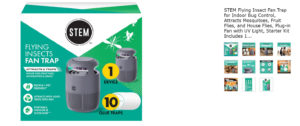
STEM Flying Insect Fan Trap Specifications
The STEM Flying Insect Fan Trap is designed as an indoor flying-insect capture device rather than a chemical insecticide dispenser.
Its main components include a UV light, an internal fan, an enclosed adhesive trap, touch controls, adjustable fan speeds, and timer settings. The starter kit includes the device, five glue traps, and a six-foot power cord. The product is designed with multiple operating-duration options, including shorter timed sessions and continuous operation.
According to the official STEM product page, the device uses light to attract flying insects and airflow to pull them toward the adhesive trap.
The device is marketed for several common flying pests, particularly fruit flies, gnats, mosquitoes, house flies, and other small flying insects.
The basic operating principle is straightforward. The light draws insects toward the opening, the fan helps pull them into the device, and the adhesive pad captures them.
Unlike an electric bug zapper, the insects are not electrocuted. The device relies on physical trapping through its glue pad.
STEM Flying Insect Fan Trap Design and Build Quality
One thing that stands out about the product is that it does not look particularly aggressive for something designed to catch bugs.
The compact cylindrical design allows it to sit on a kitchen counter, desk, shelf, bathroom surface, or other indoor location without looking like commercial pest-control equipment.
The enclosed glue trap is also a thoughtful design choice. Instead of having a sticky strip hanging visibly from the ceiling or wall, the adhesive surface remains inside the device.
A review from Apartment Therapy described the device as compact enough to occupy a relatively small amount of counter space and tested it specifically against flying insects in a home environment.
The overall construction, however, receives more mixed feedback.
Several users praise the compact appearance and simple setup, but some customer reviews have questioned the quality of the plastic or complained about fan noise and controls. Current customer feedback can be compared directly through Lowe’s STEM Flying Insect Trap reviews before purchasing.
So while the design is convenient, I would not automatically classify it as a heavy-duty appliance.

STEM Flying Insect Fan Trap Claims and How They Hold Up
STEM’s main claim is that its UV light and fan work together to attract and capture flying insects.
That claim is consistent with the way the device is designed. The manufacturer states that the UV light attracts insects while the fan helps pull them toward the insecticide-free glue trap. More details about the operating mechanism are available on the STEM official product information page.
The more interesting question is whether that translates into meaningful pest reduction.
There is considerable customer feedback suggesting that it does.
Retailer ratings have generally been favorable, with customers frequently mentioning fruit flies, gnats, mosquitoes, quiet operation, and ease of replacing the adhesive traps. Walmart’s customer listing provides another useful source for comparing buyer experiences.
However, customer ratings are not the same thing as controlled scientific evidence.
Some reviews may also be collected through retailer review programs or promotional arrangements. That does not automatically make those experiences unreliable, but it is worth remembering when judging overwhelmingly positive review sections.
STEM Flying Insect Fan Trap Effectiveness Against Mosquitoes
Mosquito performance is one area where expectations should be controlled.
Some customers report finding mosquitoes inside the trap after leaving it running overnight. Other users have reported reductions in mosquitoes and gnats after placing the device in darker areas.
However, this should not be interpreted as proof that the trap can control an entire mosquito population.
Mosquito behavior varies by species and environmental conditions. The CDC’s mosquito-control guidance recommends using multiple prevention measures, including eliminating standing water, using screens, and taking steps to prevent mosquito bites.
That is important because a flying-insect trap only deals with insects that enter its attraction zone.
If mosquitoes are entering through damaged screens or breeding in standing water around the property, the underlying source still needs attention.
The most realistic interpretation is that the STEM trap can capture some mosquitoes indoors, but it should not be treated as a complete mosquito-control system.
STEM Flying Insect Fan Trap Effectiveness Against Fruit Flies and Gnats
This appears to be one of the stronger use cases for the device.
Numerous customers report catching fruit flies and gnats, sometimes filling the adhesive pad within a relatively short period.
A review published by Apartment Therapy also examined the device specifically for flying insects and compared it with homemade fruit-fly traps.
The attraction of this approach is obvious. There is no open container of vinegar or sugary liquid sitting on the counter, and the captured insects remain inside the device.
Still, there is an important limitation.
The trap does not remove the source of a fruit-fly or gnat infestation. The University of Minnesota Extension explains that fruit flies can reproduce around fermenting or decaying organic material, which means eliminating breeding sources remains important.
The trap may reduce adult insects while the underlying problem continues.
STEM Flying Insect Fan Trap Health Hazards
One of the strongest selling points is that the device does not use chemical insecticides.
STEM describes the glue trap as insecticide-free and markets the device for indoor use. Details about the manufacturer’s safety directions can be checked on the official STEM website.
That eliminates one category of exposure associated with conventional insecticide sprays.
It does not, however, mean that the product is completely risk-free.
The adhesive pads are sticky by design and should not be handled unnecessarily. Used traps can contain dead insects, so sensible hygiene practices still apply when replacing them.
The device should also be kept away from water and handled according to the manufacturer’s instructions.
It is worth clarifying one common misunderstanding about the word “UV.”
This is not the same thing as a UV-C disinfection lamp. The light is being used as an insect attractant. It should not be purchased with the expectation that it sterilizes the surrounding room.
STEM Flying Insect Fan Trap Safety Around Children and Pets
The enclosed design gives the product an advantage over exposed sticky traps and hanging fly paper.
The glue pad remains inside the unit during normal operation, meaning children and pets have less direct access to the adhesive surface.
However, pet owners should not interpret “pet friendly” as meaning the device can safely be chewed, knocked over, or repeatedly handled by an animal.
The ASPCA’s guidance on household pest-control products is useful for pet owners who are concerned about accidental exposure to household pest-control products.
The safest approach is still to position the device where children and pets cannot easily interfere with it.
STEM Flying Insect Fan Trap Durability
Durability is probably one of the less settled areas of the product.
There are customers who describe the device as well made and convenient enough for continued use, while others have questioned the quality of the plastic or complained about fan noise and controls.
Current Target customer reviews provide examples of both positive and negative experiences, including comments about fan noise and overall operation.
That tells me something important.
The product does not appear to have a universal durability or performance experience. There are plenty of satisfied owners, but buyers should not expect premium-appliance construction from a compact consumer pest trap.
STEM Flying Insect Fan Trap Customer Reviews
The overall customer response is favorable.
Customers commonly mention fruit flies, gnats, mosquitoes, quiet operation, easy setup, simple trap replacement, and the absence of an insecticide smell.
Positive reviews can be found across retailers such as Walmart and Lowe’s.
But the negative reviews are worth reading too.
Some customers report weak suction, inconsistent touch controls, limited attraction, or disappointing results. These reviews are important because they demonstrate that the device is not guaranteed to work equally well in every environment.
That difference in experience is probably why some people become huge fans of the product while others conclude that it is essentially an expensive sticky trap with a light and fan attached.
STEM Flying Insect Fan Trap Replacement Traps
Replacement cost is an important part of the ownership equation.
The starter kit includes glue traps, but the adhesive pads are consumables rather than permanent components.
STEM sells replacement pads separately through its official replacement-trap page.
How quickly you use them depends on the number of insects in the environment.
A household with occasional gnats may use a trap relatively slowly. Someone dealing with a serious fruit-fly problem could burn through replacement pads much faster.
That means the actual long-term cost is not simply the price of the machine.
It is the machine plus replacement traps over time.
STEM Flying Insect Fan Trap Compared With Bug Sprays
The STEM trap has one obvious advantage over conventional insect sprays.
There is no need to spray insecticide around the room.
The device captures insects mechanically using light, airflow, and adhesive material. STEM specifically markets the system as insecticide-free.
That can be attractive in kitchens, bedrooms, offices, and homes where people do not want chemical sprays being used frequently.
The downside is that sprays can provide immediate knockdown against insects that are already visible, whereas this device depends on insects approaching the trap.
For readers interested in understanding the safety considerations surrounding household pesticides, the U.S. Environmental Protection Agency’s pesticide safety information is a useful independent reference.
STEM Flying Insect Fan Trap Compared With Homemade Fruit Fly Traps
Homemade fruit-fly traps using apple cider vinegar and dish soap are cheap and can work surprisingly well.
The downside is that they can smell, look unpleasant, and require a container of liquid sitting around.
Apartment Therapy’s review compared the STEM trap with homemade apple-cider-vinegar traps and highlighted convenience as one of the reasons someone might choose the commercial device.
The trade-off is cost.
Vinegar and dish soap are inexpensive household products. STEM requires the initial device and ongoing replacement glue traps.
So convenience is one of the main things you are paying for.
STEM Flying Insect Fan Trap Limitations
The biggest mistake would be treating this as an all-purpose insect exterminator.
The product is most convincing when used against small flying insects in enclosed indoor spaces.
Large flies may be more difficult for the fan to capture, and customer feedback shows that results can vary according to insect type and placement.
Placement also matters.
The device is more likely to be useful when positioned close to insect activity rather than hidden somewhere across the room. A darker environment can also make an illuminated trap more noticeable to insects.
The device cannot replace sanitation.
If your kitchen has uncovered fruit, overflowing waste, food residue, blocked drains, or another source of insects, the trap is dealing with the adults rather than eliminating the reason they keep appearing.
STEM Flying Insect Fan Trap Pros and Cons
STEM Flying Insect Fan Trap Pros
- Insecticide-free operation
- No strong chemical smell
- Enclosed adhesive trap
- Quiet compared with traditional electric zappers
- Useful for fruit flies and gnats
- Can capture some mosquitoes
- Compact countertop design
- Adjustable operating times
- Replaceable glue traps
- Simple maintenance
STEM Flying Insect Fan Trap Cons
- Results vary by insect type
- Large flies may be difficult for the fan to capture
- Replacement traps create an ongoing cost
- Some users report weak airflow
- Some users report inconsistent controls
- Fan noise may become noticeable at higher settings
- It does not address insect breeding sources
- It is intended for indoor use
STEM Flying Insect Fan Trap Is It Worth the Hype
This is where the marketing needs to be separated from reality.
The product is not a gimmick in the sense that there is substantial customer feedback showing that the trap can capture flying insects.
Retailer ratings are generally strong, and many reviews specifically mention fruit flies, gnats, and mosquitoes.
At the same time, the product is not universally effective.
Some users report weak suction, inconsistent controls, or poor attraction. That means the device should not be presented as a guaranteed solution.
There is also an important distinction between catching insects and eliminating an infestation.
The STEM trap can potentially reduce the number of adult flying insects in a room. It cannot clean a drain, remove rotting produce, dry out overwatered soil, repair a window screen, or eliminate standing water.
Those jobs still belong to the homeowner.
STEM Flying Insect Fan Trap Final Verdict
The STEM Flying Insect Fan Trap makes the most sense for someone who wants a relatively clean and low-maintenance way to reduce small flying insects indoors without repeatedly spraying insecticide.
Its strongest reported use cases are fruit flies, gnats, and smaller flying pests. Mosquito capture also appears in customer reports, although that should not be interpreted as complete mosquito control.
The product receives strong overall customer ratings, but the mixed reviews around fan strength, controls, noise, and durability are important enough that I would not call it flawless.
For a person dealing with occasional flying insects, the convenience may justify the purchase.
For someone dealing with a serious infestation, I would treat the STEM trap as one layer of pest management rather than the entire solution.
The smartest setup would be to combine the trap with proper food storage, regular waste disposal, drain hygiene, window screening, and removal of standing water or other breeding sources.
That is less exciting than saying one little machine will solve everything, but it is also considerably more realistic.
STEM Flying Insect Fan Trap Frequently Asked Questions
What is the STEM Flying Insect Fan Trap?
The STEM Flying Insect Fan Trap is an indoor pest-control device that uses light, airflow, and an adhesive glue trap to capture flying insects. The official STEM product information provides the manufacturer’s description of how the system works.
Does the STEM Flying Insect Fan Trap use insecticide?
STEM describes the adhesive trap as insecticide-free. This makes it different from conventional chemical insect sprays.
Does the STEM Flying Insect Fan Trap kill mosquitoes?
The device captures mosquitoes on the adhesive trap rather than killing them through an electrical zap. Customer experiences suggest that mosquitoes can be captured, although effectiveness varies.
Is the STEM Flying Insect Fan Trap safe around pets?
The device is marketed for indoor use and does not rely on insecticide, but it should still be kept out of reach of children and pets. Pet owners can also consult the ASPCA Animal Poison Control resources when dealing with accidental exposure to household products.
Can the STEM Flying Insect Fan Trap be used outdoors?
The standard device is designed for indoor use. Buyers should follow the manufacturer’s instructions rather than assuming that the unit is weatherproof.
How often should the STEM Flying Insect Fan Trap glue trap be replaced?
The adhesive trap should be replaced when it becomes full or loses its ability to capture insects. Replacement packs are available through the STEM official website.
Is the STEM Flying Insect Fan Trap noisy?
Most customers describe it as relatively quiet, although some users report a noticeable hum at higher fan settings. Reading recent Lowe’s customer reviews is useful for seeing the range of experiences.
Does the STEM Flying Insect Fan Trap work on fruit flies?
Fruit flies appear to be one of the more commonly reported successful use cases. Customers across multiple retailers report finding fruit flies on the adhesive traps.
Does the STEM Flying Insect Fan Trap eliminate an insect infestation?
No. It can capture adult flying insects, but it does not remove breeding sources such as food waste, standing water, damp drains, or decaying organic material.
Is the STEM Flying Insect Fan Trap worth buying?
Its value depends on the type and severity of the insect problem. Customer feedback is generally favorable, particularly for small flying insects, but there are also reports of weak airflow, inconsistent controls, and limited effectiveness.
STEM Flying Insect Fan Trap Buyer Checklist
Before buying, consider the following
- Are you mainly dealing with gnats or fruit flies?
- Are mosquitoes part of the problem?
- Do you want an insecticide-free option?
- Are replacement glue traps easily available?
- Can you position the device close to insect activity?
- Are you comfortable paying for replacement adhesive traps?
- Have you already removed food and moisture sources attracting insects?
- Do you need a device for indoor rather than outdoor pest control?
For the manufacturer’s specifications, operating instructions, and current product information, check the official STEM Flying Insect Fan Trap page.
For independent customer experiences, compare recent reviews from Lowe’s, Walmart, and Target rather than relying exclusively on the Amazon product description.