
Tell City Hall Review
Tell City Hall is a Canadian public opinion research program that has attracted attention because its name sounds like an official municipal service. People have reported receiving automated calls, text messages and emails connected with Tell City Hall, sometimes without expecting them. This has led to questions about whether Tell City Hall is legitimate, whether it is connected to local governments and whether scammers could be using the name.
The evidence available from government and research-industry sources points to a more complicated picture. Tell City Hall is associated with Advanis, a Canadian market and social research company. Advanis describes Tell City Hall as a probability-based sample source for government clients. Government research documents also show that Tell City Hall has been used to recruit participants for public-sector surveys.
However, being a legitimate survey program does not mean every unexpected call displaying the name should automatically be trusted. Caller ID can be manipulated, links can be impersonated and criminals can use legitimate company names in phishing attempts.
This Tell City Hall review examines the reported scam concerns, how the service works, what legitimate Tell City Hall contact may look like and the warning signs consumers should watch for.
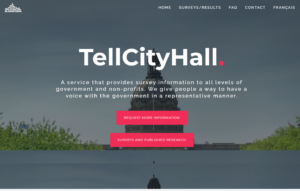
Tell City Hall Review and Legitimacy
The first question many people ask is whether Tell City Hall is a scam.
Based on available evidence, Tell City Hall itself appears to be a legitimate research program rather than a conventional financial scam. Advanis identifies Tell City Hall as a service used in its public-sector research work, including research for government departments and other public organizations.
Government of Canada research documentation provides additional evidence. A Parks Canada study states that Advanis was hired to administer the research and used its Tell City Hall methodology. The documentation describes participants as being randomly selected and says participation was voluntary and confidential.
That distinction is important.
A person can receive a genuine Tell City Hall survey and still reasonably think the call looks suspicious. The name sounds like a government office, while the actual organization conducting the research is a private market research company.
Tell City Hall Review and Its Connection to Advanis
Tell City Hall is connected to Advanis, a Canadian market and social research company.
Advanis states that Tell City Hall provides a probability-based sample source of mobile-enabled Canadians for its government clients. Its public research work covers areas including education, health, food and agriculture, government programs and social research.
Advanis Social and Public Research information
This explains why a Tell City Hall survey can sometimes ask about subjects that appear to have nothing to do with the respondent’s city.
The research may concern public policy, government programs, community services or broader social issues. Historical Canadian government research documents show Tell City Hall being used for surveys relating to topics such as national parks and children’s healthcare.
Tell City Hall Review and Why the Name Causes Confusion
The name is arguably the biggest reason people suspect a scam.
“Tell City Hall” sounds like a direct communication channel to a municipal government. A person receiving a call may reasonably assume that their city council or local authority is contacting them.
That assumption is not always correct.
The City of Sarnia previously warned residents that Tell City Hall surveys were not conducted in partnership with the city or Sarnia Police Services. The city explained that residents could receive emails, text messages and telephone calls displaying Tell City Hall even though the communication did not originate from Sarnia City Hall.
This creates an important distinction.
Tell City Hall can be legitimate without being your city hall.
The organization may conduct research for public-sector clients, but that does not mean every city whose residents receive a survey has personally commissioned that particular survey.
Tell City Hall Review and Reported Scam Attempts
Reports surrounding Tell City Hall generally fall into two different categories.
The first involves people receiving legitimate but unwanted or unexpected research calls. Some recipients have complained about repeated contact or calls they did not request. Others report completing surveys without encountering suspicious requests. User reports therefore vary considerably.
The second category is more concerning. This involves a hypothetical or actual scammer using the Tell City Hall name to appear credible.
A legitimate organization can itself become the subject of impersonation. This happens with banks, delivery companies, government agencies and research organizations.
For example, someone could claim to be conducting a Tell City Hall survey and then ask for information that has no legitimate reason to be collected during a public opinion survey.
That is where consumers should draw a hard line.
Tell City Hall Review and Suspicious Information Requests
A survey asking your opinion about public services is one thing.
A caller asking for your bank password is another.
Consumers should be particularly cautious if someone claiming to represent Tell City Hall requests sensitive information such as
- Banking passwords
- Debit or credit card numbers
- Online banking login details
- One-time authentication codes
- Password reset codes
- Unnecessary government identification numbers
- Payment to participate in a survey
- Cryptocurrency or gift cards
- Remote access to a computer or phone
The City of Sarnia specifically stated that there is no cost to participate in a municipal survey and that banking or payment information is not required.
This is one of the most useful practical checks when assessing a suspicious Tell City Hall interaction.
Tell City Hall Review and Fake Survey Links
Another potential scam route is phishing.
A criminal can create a website that resembles a legitimate survey page and send it through SMS or email. The message might use Tell City Hall’s name, branding or wording to make the recipient believe the link is safe.
Government research documentation shows that legitimate Tell City Hall studies can send participants an SMS or email containing a survey link after telephone recruitment.
That means the existence of a text message alone does not prove fraud.
The safer approach is to inspect the destination carefully and verify the survey independently before entering information.
Do not rely solely on the appearance of a webpage. Scammers can copy logos, colours and layouts remarkably well.
Tell City Hall Review and Caller ID Spoofing
Caller ID is not a reliable authentication system.
A phone displaying “Tell City Hall” does not prove that the caller is actually affiliated with Tell City Hall. Fraudsters can manipulate caller identification information to make calls appear to originate from trusted organizations.
This is particularly relevant when dealing with survey brands because legitimate survey organizations already make automated calls.
A suspicious caller can therefore hide inside the noise created by legitimate research activity.
The correct question is not simply “Does my phone say Tell City Hall?”
The better question is “Does this particular interaction behave like a legitimate survey?”
Tell City Hall Review and Legitimate Survey Characteristics
Available government research documents provide useful examples of how legitimate Tell City Hall research can operate.
Parks Canada documentation describes a Tell City Hall recruitment process involving random dialing of mobile numbers. Individuals who agreed to participate could receive a text message containing a link to a mobile-optimized survey.
Another Government of Canada survey using Tell City Hall methodology states that participation was voluntary and confidential and that respondents were randomly selected.
A current York Region community opinion survey also states that its third-party research vendor may display “Tell City Hall” on caller ID.
This is strong evidence that the Tell City Hall name can legitimately appear during public-sector research.
Tell City Hall Review and Government Partnerships
There is another reason people may become confused.
A Tell City Hall call can relate to government research without the caller actually being a government employee.
For instance, York Region states that its community opinion survey is conducted by a CRIC-accredited third-party research vendor and that caller ID may display Tell City Hall.
Similarly, historical Government of Canada research documents show Advanis administering surveys using Tell City Hall methodology.
Therefore, the relationship can look something like this
Government organization → research project → third-party research company → Tell City Hall → participant
That is very different from
City Hall → government employee → resident
Understanding this structure removes much of the confusion.
Tell City Hall Review and Negative User Reports
Not every complaint should be dismissed.
Some users have reported repeated calls after they had already declined participation. Others have described the calls as annoying or intrusive. There are also users who say they verified the surveys and completed them without experiencing problems.
These experiences demonstrate why a neutral review is more appropriate than simply calling Tell City Hall either “safe” or “a scam.”
A legitimate organization can still have poor communication practices from a user’s perspective.
Likewise, an organization can be legitimate while criminals impersonate it.
The existence of negative reports therefore deserves attention, but it should not automatically be interpreted as proof of criminal activity.
Tell City Hall Review and How to Handle an Unexpected Call
If you receive an unexpected Tell City Hall call, you do not have to participate.
If you are interested in the survey, ask the caller what organization is sponsoring the research and what the research is about.
If you are uncomfortable, end the call and independently verify the information.
Never allow urgency to dictate your decision.
A legitimate opinion survey should not need to threaten you, pressure you into making a payment or demand confidential authentication information.
You can also contact the organization through independently verified contact information rather than relying on details provided by the caller.
Tell City Hall Review and Opting Out
People who do not want to participate in Tell City Hall research can seek removal from future contact.
Published information about Tell City Hall identifies an opt-out process through its contact channels. Before using contact details found in an unexpected message, it is sensible to independently verify them through the organization’s official website.
Tell City Hall official website
This is preferable to replying directly to a suspicious SMS or clicking an unfamiliar link.
Tell City Hall Review and Online Safety
The safest approach is to treat unexpected survey communications with the same basic caution applied to other unsolicited messages.
The Canadian Anti-Fraud Centre provides consumer guidance on recognizing and reporting fraud, while the Canadian Radio-television and Telecommunications Commission provides information about unwanted telecommunications and the National Do Not Call List.
These resources are useful if an interaction goes beyond an ordinary survey and starts to resemble phishing, impersonation or financial fraud.
Tell City Hall Review Verdict
The evidence currently available does not support calling Tell City Hall itself a scam.
Tell City Hall is associated with Advanis and has documented use in Canadian public-sector research. Government sources also confirm that legitimate research campaigns can display Tell City Hall on caller ID and can use telephone calls followed by SMS or online questionnaires.
The bigger concern is the potential for confusion and impersonation.
Someone receiving an unsolicited call should not assume that “Tell City Hall” means their local government is calling. At the same time, receiving a Tell City Hall survey does not by itself prove that the caller is fraudulent.
The strongest warning signs are requests for money, banking credentials, passwords, authentication codes or other sensitive information.
In short, Tell City Hall appears to be a legitimate research program, but individual communications should still be verified before you share information or click links.
Frequently Asked Questions About Tell City Hall Review
Is Tell City Hall a scam?
No clear evidence reviewed for this article establishes Tell City Hall itself as a scam. Advanis identifies Tell City Hall as part of its public-sector research activities, and Canadian government research documents confirm its use in legitimate surveys.
Is Tell City Hall actually City Hall?
No. Tell City Hall is associated with Advanis, a private research company. A caller displaying Tell City Hall should not automatically be interpreted as an employee of your local municipal government.
Why did Tell City Hall call me?
You may have been randomly selected for a public opinion or policy survey. Government research documentation shows that Tell City Hall methodology can involve random dialing and subsequent SMS or email invitations.
Can Tell City Hall ask for my bank information?
A legitimate public opinion survey should not require your banking password, card details or payment information. If someone requests these details, stop the interaction and verify the communication independently.
Is a Tell City Hall text message automatically a scam?
No. Legitimate Tell City Hall research can use SMS invitations. Government research documentation confirms that participants may receive text messages containing survey links.
Can scammers impersonate Tell City Hall?
Yes. The existence of a legitimate company does not prevent criminals from impersonating its name. Always evaluate the specific call, message and website rather than trusting caller ID alone.
Does Tell City Hall work with governments?
Advanis states that Tell City Hall is offered as a sample source to government clients. Government research documents also show Tell City Hall methodology being used for public-sector surveys.
Should I participate in a Tell City Hall survey?
Participation is your choice. If you are comfortable with the survey after verifying its legitimacy, you can participate. If you are uncomfortable or suspect impersonation, you can decline.
How do I stop Tell City Hall calls?
Use the official Tell City Hall contact or opt-out process rather than replying to an unsolicited message or using a link supplied by a suspicious caller.
Tell City Hall Review Final Assessment
Tell City Hall is a good example of why online scam reviews need context.
Calling it a scam simply because people receive unsolicited calls would overlook substantial evidence from Advanis and Canadian government sources. Calling every communication legitimate simply because the organization exists would be equally careless.
The sensible position is somewhere in the middle.
Tell City Hall appears to be a legitimate Canadian research program, but the name does not mean that your local city hall is contacting you.
Consumers should verify unexpected communications, avoid sharing sensitive financial or authentication information and remain alert for impersonation attempts.
That approach provides a more useful answer than either extreme of “completely safe” or “definitely a scam.”