
Ultrasonic Retainer Cleaner Machine Review
Keeping a retainer, aligner, mouth guard or denture clean sounds simple until the appliance starts developing an unpleasant smell, cloudy appearance or stubborn buildup. Brushing can help, but getting into every small contour without scratching the material is another story.
The Ultrasonic Retainer Cleaner Machine 48kHz Dental Ultrasonic Care Cleaner is designed to make that routine less tedious. The compact cleaning pod uses ultrasonic technology and UV-C light, with multiple cleaning modes intended for removable dental appliances and other small items.
But does the technology actually make a meaningful difference, or is this another small appliance riding on impressive-sounding cleaning claims?
This review looks at the product specifications, cleaning technology, safety considerations, manufacturer claims, expected effectiveness, customer feedback and whether the Ultrasonic Retainer Cleaner Machine is actually worth the hype.
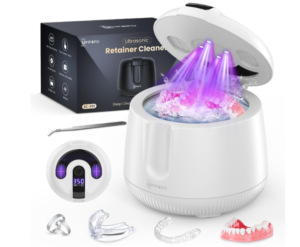
Ultrasonic Retainer Cleaner Machine Specifications
The product identified by ASIN B0HGXC2J1Y is listed as a 48kHz ultrasonic dental cleaning machine. Available product information lists a water capacity of approximately 6.8 fl oz, which is about 200 mL.
The listed specifications include
- Product type 48kHz ultrasonic retainer cleaner
- Ultrasonic frequency 48,000 Hz
- Water capacity approximately 6.8 fl oz or 200 mL
- Four cleaning modes
- Ultrasonic cleaning
- UV-C light function
- Pulse-flow cleaning technology
- Operating noise claimed at below 38 dB
- Compact portable design
- Designed for one dental appliance at a time
- Includes a charging cable
- Includes precision tweezers
- Includes a microfiber cleaning cloth
- Includes a storage bag
- Available in white and black versions
The product information also describes dimensions of approximately 4.646 × 4.646 × 4.331 inches for the packaged product and a packaged weight of around 0.53 kg.
One thing worth noticing is the relatively small 200 mL-class tank. That is not necessarily a disadvantage because the machine is intended primarily for small appliances rather than large household objects.
The capacity is enough for a retainer, aligner, mouth guard or similar item without taking up much countertop space.
Ultrasonic Retainer Cleaner Machine Cleaning Technology
The central feature here is the 48kHz ultrasonic system.
Ultrasonic cleaners work by sending high-frequency sound waves through water. These waves create microscopic bubbles that form and collapse rapidly. The resulting cavitation helps loosen particles and deposits from surfaces, including areas that can be difficult to reach with conventional brushing.
That makes the technology particularly interesting for retainers and aligners because these appliances contain curves, edges and small spaces where residue can accumulate.
There is legitimate evidence supporting ultrasonic cleaning for removable oral appliances. The American Dental Association’s discussion of ultrasonic versus conventional denture cleaning reports research in which both cleaning approaches improved plaque-related outcomes, while the ultrasonic approach combined with cleanser produced greater improvements in denture cleanliness and patient satisfaction.
The important distinction is that ultrasonic cleaning is not the same thing as sterilization.
The machine can help physically remove contamination. That does not automatically mean every microorganism has been eliminated.
Ultrasonic Retainer Cleaner Machine 48kHz Performance
A 48kHz operating frequency is within the range commonly seen in consumer ultrasonic cleaners designed for dental appliances.
The machine’s product information claims that its ultrasonic system produces millions of microscopic bubbles per second. That sounds dramatic, but the number of bubbles by itself does not determine how effective a cleaner will be.
Actual performance depends on factors such as
- Ultrasonic frequency
- Transducer power
- Water volume
- Appliance position
- Cleaning time
- Type of buildup
- Cleaning solution
- Condition of the retainer
- Frequency of cleaning
Therefore, a 48kHz label should not be interpreted as proof that this particular machine will outperform every other ultrasonic cleaner.
Its advantage is that the frequency is paired with a purpose-built small cleaning chamber and preset cycles intended for dental appliances.
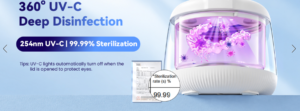
Ultrasonic Retainer Cleaner Machine Cleaning Modes
One of the more interesting features is the four-mode setup.
According to the available product information, the modes include
Mode 1
Five minutes of ultrasonic cleaning followed by five minutes of UV-C exposure.
Mode 2
Ten minutes of ultrasonic cleaning followed by ten minutes of UV-C exposure.
Mode 3
Ten minutes of ultrasonic cleaning without UV-C.
Mode 4
A UV-C-only cycle.
Having separate modes gives users more control over how much cleaning the appliance receives.
For routine daily maintenance, running the longest available cycle every time may not necessarily be necessary. The appropriate cycle should depend on the appliance manufacturer’s cleaning instructions and the condition of the appliance.
The American Association of Orthodontists retainer-care guide recommends regular cleaning and notes that ultrasonic retainer cleaners and appropriate cleaning solutions can be used as part of retainer care.
Ultrasonic Retainer Cleaner Machine Pulse-Flow Technology
Another claim attached to this model is its pulse-flow cleaning technology.
The product description says the longer ultrasonic and UV-C cycle uses a two-second work and two-second rest pattern. The manufacturer claims that this design can increase cleaning efficiency by up to 30% compared with continuous vibration while being gentler on aligners and retainers.
That 30% figure should be treated as a manufacturer claim rather than an independently established performance result for this particular machine.
There is a reasonable concept behind pulsed operation because cleaning performance can depend on how ultrasonic energy interacts with the water and object being cleaned. However, a specific percentage improvement requires controlled testing to establish.
This is an important distinction when evaluating Amazon products. A technical-sounding percentage does not automatically equal independently verified performance.
Ultrasonic Retainer Cleaner Machine UV-C Claims
The addition of UV-C is probably one of the biggest selling points.
UV-C radiation can have antimicrobial effects when microorganisms receive an adequate dose. However, effectiveness depends on factors including wavelength, intensity, exposure time, distance and whether the light actually reaches the microorganisms.
The product description markets the UV-C function as providing deep cleaning and helping eliminate residual odors.
That should not be interpreted as proof that the machine sterilizes a retainer.
A safer way to understand the feature is that UV-C is an additional antimicrobial-oriented function, while ultrasonic cavitation provides the mechanical cleaning action.
Safety is particularly important here. The FDA’s guidance on ultraviolet radiation warns that direct UVC exposure can cause serious eye injury and skin burns.
The machine also reportedly incorporates an automatic UV shutoff when the lid is opened. That is an important safety feature if it operates as described because it limits direct exposure to the UV source.
Users should still avoid deliberately looking into the UV-C source or operating the machine with the safety mechanism bypassed.
Ultrasonic Retainer Cleaner Machine Safety
Safety matters more than flashy cleaning claims when a device is intended for something that goes directly into the mouth.
The first issue is water temperature.
Retainers and clear aligners can be made from heat-sensitive plastics. Hot or boiling water may distort some appliances and affect their fit. The American Association of Orthodontists recommends cool or lukewarm water and specifically warns against hot water.
The second issue is cleaning solutions.
Not every retainer is compatible with every chemical cleaner. Harsh household chemicals, bleach or abrasive products should not be added simply because the machine can circulate them.
A cleaning tablet or solution should only be used if it is appropriate for the specific dental appliance.
The AAO also advises against toothpaste for routine retainer cleaning because abrasive ingredients can scratch the appliance.
The third issue is UV-C exposure.
The automatic shutoff feature is useful, but users should not treat the machine as a toy or attempt to operate it with the lid open.
The fourth issue is appliance compatibility.
A retainer that has become cracked, warped or damaged should not necessarily be placed into an ultrasonic cleaner without checking with a dental professional.
The safest approach is to follow the cleaning instructions supplied by the orthodontist, dentist or appliance manufacturer.
Ultrasonic Retainer Cleaner Machine Effectiveness
The evidence supporting ultrasonic cleaning itself is more convincing than the evidence supporting every marketing claim made by individual consumer machines.
The American Dental Association has reported research comparing ultrasonic denture cleaning with conventional cleaning. Both approaches improved plaque coverage and denture-related outcomes, while the ultrasonic intervention combined with cleanser produced greater improvements in cleanliness and patient satisfaction in that particular study.
That does not mean every inexpensive consumer ultrasonic pod will produce identical results.
Still, it supports the basic idea that ultrasonic cleaning can be a useful method for removable oral appliances.
The strongest practical benefit is likely to be routine maintenance.
An ultrasonic cleaner can loosen food residue, plaque deposits and other debris without requiring aggressive brushing of every surface.
It is less realistic to expect the machine to completely restore an old retainer covered in years of hardened deposits or severe discoloration.
For additional context, the American Dental Association’s denture-care guidance recommends daily cleaning of dentures and emphasizes the importance of appropriate nonabrasive cleaning methods.
Ultrasonic Retainer Cleaner Machine and Stubborn Stains
Staining is another area where Amazon marketing can create unrealistic expectations.
Ultrasonic cleaning can help loosen deposits contributing to discoloration, particularly when the appliance is cleaned regularly. However, deep staining that has developed over a long period may not disappear after a few cycles.
The difference is important.
An ultrasonic cleaner is primarily a maintenance tool, not a cosmetic restoration machine.
Regular cleaning can help prevent buildup from becoming difficult to remove in the first place. Once deposits become heavily established, professional cleaning or replacement may sometimes be more appropriate.
Ultrasonic Retainer Cleaner Machine for Aligners and Mouth Guards
The compact design makes this machine particularly suitable for people who regularly use removable oral appliances.
Potentially compatible items include
- Clear aligners
- Retainers
- Night guards
- Sports mouth guards
- Dentures
- Orthodontic appliances
- Toothbrush heads
The manufacturer also promotes the machine for jewelry and other small accessories.
That versatility can make the device more useful than a machine purchased exclusively for one retainer.
However, the cleaning instructions for each item should always take priority over the product’s general compatibility claims.
The AAO also recommends cool-water cleaning for mouth guards and warns against hot water because heat can warp plastic appliances. (AAO mouthguard and retainer care guidance).
Ultrasonic Retainer Cleaner Machine Noise Level
The product information claims an operating noise level below 38 dB.
That would put it in the relatively quiet category for a small countertop appliance.
In practical terms, the machine should be much less disruptive than many household appliances. Still, manufacturer noise ratings can be measured under controlled conditions, so real-world sound may vary depending on the surface underneath the unit, water level and operating cycle.
For a bedroom or shared bathroom, quieter operation is nevertheless a useful feature.
Ultrasonic Retainer Cleaner Machine Customer Reviews
The available marketplace data for ASIN B0HGXC2J1Y currently shows a 4.8-star rating from approximately 170 reviews.
That is a strong customer rating, although the review count is considerably smaller than some established ultrasonic cleaner models with thousands of reviews.
This distinction matters.
A 4.8-star rating based on roughly 170 reviews provides useful customer feedback, but it should not be treated as equally robust evidence as a product with several thousand verified purchases and a long review history.
The broader ultrasonic retainer cleaner category currently contains products with widely varying review counts and ratings. Marketplace data shows that several competing models have accumulated hundreds or thousands of reviews, while others have relatively small review histories.
For this particular machine, the high rating is encouraging, but the relatively modest review volume means buyers should still pay attention to individual customer comments rather than looking only at the star rating.
Ultrasonic Retainer Cleaner Machine Customer Experience
The likely appeal of this product is convenience.
A user does not need to stand over a sink brushing every corner of a retainer. The appliance can be placed inside the tank, water can be added and a cleaning cycle selected.
That makes the machine particularly attractive to people who wear retainers or aligners daily.
However, expectations should remain realistic.
A positive review saying that a retainer “looks brand new” is a personal experience, not laboratory evidence. Likewise, a negative review saying that the machine “did nothing” may reflect a heavily stained appliance, incorrect cleaning solution, unsuitable expectations or a defective unit.
Customer reviews are valuable for identifying patterns such as durability, noise, ease of use and whether the machine stops working after repeated cycles. They are less reliable for proving microbiological claims.
Ultrasonic Retainer Cleaner Machine Pros and Cons
Ultrasonic Retainer Cleaner Machine Pros
- 48kHz ultrasonic cleaning
- Four cleaning modes
- UV-C function
- Compact countertop design
- Approximately 200 mL water capacity
- Designed specifically around small dental appliances
- Can potentially clean more than retainers
- Pulse-flow cleaning mode
- Claimed operating noise below 38 dB
- Automatic UV shutoff when the lid is opened
- Portable design
- Accessories included
- Strong current customer rating
Ultrasonic Retainer Cleaner Machine Cons
- The 30% efficiency improvement is a manufacturer claim
- UV-C should not automatically be interpreted as sterilization
- The relatively small tank limits larger items
- Customer review volume is still modest compared with established competitors
- Deep or old staining may remain
- Effectiveness can depend on the cleaning solution used
- Dental appliances may have manufacturer-specific cleaning requirements
- The machine is not a replacement for normal oral hygiene
- Long-term durability is difficult to establish from a relatively young product listing
Ultrasonic Retainer Cleaner Machine vs Manual Cleaning
Manual cleaning has one obvious advantage.
It is cheap.
A soft toothbrush, appropriate cleaning method and clean water can handle basic retainer maintenance without requiring another electronic appliance.
The ultrasonic cleaner’s advantage is convenience and access.
Instead of relying entirely on mechanical brushing, ultrasonic waves can work around the contours of an appliance while it sits in water.
That makes the machine more compelling for people who clean their retainers frequently.
For someone who wears a retainer once every few weeks, the purchase may be harder to justify.
For someone who wears an aligner or retainer every day, the convenience becomes more meaningful.
Is the Ultrasonic Retainer Cleaner Machine Worth the Hype?
The Ultrasonic Retainer Cleaner Machine 48kHz appears to have a legitimate cleaning mechanism rather than being a completely gimmicky gadget.
The ultrasonic technology itself is well established, and research supports ultrasonic cleaning as a useful approach for removable dental appliances.
The product also offers a reasonable feature package with 48kHz ultrasonic cleaning, four modes, UV-C functionality, a compact tank and a claimed quiet operating level.
Where the hype needs to be controlled is around the stronger marketing language.
The machine should not be treated as a guaranteed sterilizer. The claimed 30% increase in cleaning efficiency has not been independently established here. The UV-C function should also be viewed as an additional feature rather than proof that every microorganism has been eliminated.
The current 4.8-star customer rating from around 170 reviews is encouraging, but the review base is still relatively small.
Overall, the product makes the most sense for people who regularly wear removable dental appliances and want a more convenient cleaning routine.
For occasional users, traditional cleaning may be perfectly adequate.
Ultrasonic Retainer Cleaner Machine Final Verdict
The Ultrasonic Retainer Cleaner Machine 48kHz sits in an interesting middle ground.
It is more sophisticated than simply brushing a retainer under running water, but it should not be confused with professional dental sterilization equipment.
Its strongest selling point is convenience. The 48kHz ultrasonic system, multiple cleaning modes and compact design make it a practical option for regular retainer, aligner, mouth guard and denture maintenance.
The UV-C feature adds another layer of functionality, although the stronger antimicrobial claims should be interpreted carefully.
The available customer rating is also positive, with the product currently listed at about 4.8 stars from approximately 170 reviews.
So, is it worth the hype?
The technology is legitimate, but the marketing deserves a reality check.
For someone who wears a retainer or aligner regularly, the machine could make cleaning easier and more consistent. For someone expecting a few minutes inside the machine to erase years of stains or guarantee complete sterilization, expectations are likely to exceed what the device can reasonably deliver.
The better way to view this product is as a convenient ultrasonic cleaning aid, not a magical dental sterilizer.
Frequently Asked Questions About the Ultrasonic Retainer Cleaner Machine
Is the Ultrasonic Retainer Cleaner Machine safe for retainers?
The machine is marketed for retainers and other removable dental appliances. However, compatibility can vary depending on the material and construction of the appliance. The cleaning instructions supplied by the dentist, orthodontist or appliance manufacturer should take priority.
Can the Ultrasonic Retainer Cleaner Machine clean Invisalign aligners?
The product is marketed for clear aligners and similar removable appliances. Users should still follow the cleaning instructions supplied with their particular aligner system.
Does the Ultrasonic Retainer Cleaner Machine sterilize retainers?
It should not automatically be described as a sterilizer. Ultrasonic cleaning helps remove contamination, while UV-C may provide antimicrobial action under appropriate conditions. Complete sterilization is a much stronger claim that depends on validated testing.
Does the Ultrasonic Retainer Cleaner Machine remove stains?
It can help loosen deposits and may improve the appearance of an appliance with regular cleaning. However, severe or deeply established staining may not disappear completely.
Can toothpaste be used in the Ultrasonic Retainer Cleaner Machine?
Toothpaste is generally not a good choice for removable dental appliances because many toothpastes contain abrasive ingredients. The American Association of Orthodontists recommends mild soap rather than toothpaste for routine retainer cleaning.
Can hot water be used in the Ultrasonic Retainer Cleaner Machine?
Hot water should not be used automatically. Some retainers and aligners can deform when exposed to high temperatures. Room-temperature or cool water is a safer default unless the appliance manufacturer specifies otherwise. The AAO specifically advises avoiding hot water because it can damage or warp retainers.
How often should an Ultrasonic Retainer Cleaner Machine be used?
Frequency depends on the appliance and the cleaning instructions provided by the dental professional. For people wearing removable appliances daily, regular cleaning is more useful than occasional intensive cleaning.
Can the Ultrasonic Retainer Cleaner Machine clean jewelry?
The product is also marketed for jewelry and other small accessories. However, delicate stones, coatings and certain metals can have specific cleaning requirements, so the item’s care instructions should be checked first.
Is the 48kHz frequency good for retainer cleaning?
48kHz is a common ultrasonic frequency range for consumer cleaning equipment. Frequency alone does not determine cleaning performance because power, water volume, cycle duration and appliance positioning also matter.
Is the Ultrasonic Retainer Cleaner Machine worth buying?
It can be worth considering for people who regularly wear retainers, aligners, mouth guards or dentures and want a convenient cleaning method. It may be unnecessary for people who rarely use removable dental appliances or are satisfied with their existing cleaning routine.
Bottom Line on the Ultrasonic Retainer Cleaner Machine
The Ultrasonic Retainer Cleaner Machine 48kHz has the features expected from a modern consumer dental-appliance cleaner, including ultrasonic cleaning, UV-C functionality, multiple modes, compact construction and a relatively quiet operating claim.
Its underlying technology is credible.
Its marketing claims require more caution.
The biggest value is likely to come from making regular cleaning easier rather than from promising extraordinary sterilization or stain-removal results. With the available customer rating sitting at approximately 4.8 stars from 170 reviews, the early customer response is positive, although the relatively small review base means long-term performance remains less established than products with thousands of reviews.
For regular retainer and aligner users, that distinction is important. A device that encourages consistent cleaning can be genuinely useful without needing to perform miracles.