
Viconor Red Light Therapy for Eyes Review
Focus keyword Viconor Red Light Therapy for Eyes
Red light therapy has become increasingly popular in the beauty and wellness market, and devices designed specifically for the eye area are now being promoted for concerns such as under-eye puffiness, tired-looking eyes, fine lines and skin ageing.
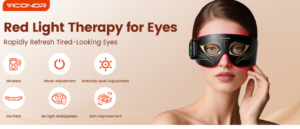
The Viconor Red Light Therapy for Eyes is one of these devices. It is a wearable LED device that uses 630nm red light and 850nm near-infrared light around the eye area. According to Viconor’s official product page, the device contains 48 dual-wavelength LEDs and is intended to be used for approximately 10 minutes per session. The manufacturer currently lists the device at about $69.99.
But there is a bigger question behind the marketing.
Does the Viconor Red Light Therapy for Eyes actually provide meaningful benefits, or is it simply another wellness gadget with impressive-sounding technology?
The answer is somewhere in the middle. Red and near-infrared photobiomodulation is a legitimate area of scientific research, but the evidence for individual consumer devices is much less straightforward.
What Is Viconor Red Light Therapy for Eyes?
The Viconor Red Light Therapy for Eyes is a wearable red and near-infrared LED device designed to sit around the eyes and under-eye region.
The product uses two reported wavelengths. These are 630nm red light and 850nm near-infrared light. Viconor says the device has 48 LEDs positioned around the eye area to provide coverage of the surrounding skin.
The device also has a silicone construction, adjustable strap, two treatment modes and two intensity levels. It comes with a rechargeable 1000mAh battery that the manufacturer says can provide up to 90 minutes of continuous use per charge.
Viconor specifically markets the product for cosmetic concerns rather than presenting it simply as a conventional eye mask.
The company’s claims include helping with fatigue-related puffiness, fine lines, brighter-looking skin and firmer-looking skin.
That distinction is important because improving the appearance of the skin around the eyes is not the same as treating an eye disease or improving eyesight.
Viconor Red Light Therapy for Eyes Benefits
The potential benefits of the Viconor Red Light Therapy for Eyes mainly fall into two categories. These are cosmetic skin benefits and possible photobiomodulation-related effects.
Viconor Red Light Therapy for Eyes and Under-Eye Puffiness
One of the main benefits promoted by Viconor is reducing the appearance of under-eye puffiness.
The manufacturer specifically describes the device as being designed for fatigue-induced puffiness and says that regular use may help produce brighter and firmer-looking skin.
This is a plausible cosmetic application for red-light therapy, although the amount of improvement will vary between individuals.
Under-eye puffiness can have many causes including lack of sleep, allergies, fluid retention, genetics and the natural anatomy of the area. Red light cannot realistically eliminate every type of under-eye bag.
So I would interpret this benefit as potential improvement in appearance rather than permanent removal of eye bags.
Viconor Red Light Therapy for Eyes and Fine Lines
Red and near-infrared photobiomodulation has also been investigated for skin-related applications.
The proposed mechanism involves light interacting with cellular processes that can influence mitochondrial activity and other signalling pathways.
More broadly, photobiomodulation is being investigated across medicine because red and near-infrared wavelengths can interact with biological tissues. The FDA’s guidance on photobiomodulation devices also recognizes PBM as a distinct category of light-based devices and discusses the testing and clinical evidence manufacturers may need for medical-device submissions.
However, this does not mean every red-light device will produce the same results.
The actual wavelength, irradiance, energy delivered, exposure duration and treatment schedule all matter.
A recent review of red and near-infrared photobiomodulation in ophthalmology also emphasizes that outcomes are device and protocol dependent, with substantial differences between wavelengths, dosimetry and treatment protocols.
Viconor Red Light Therapy for Eyes and Tired-Looking Eyes
Viconor also positions the device as a way to provide a soothing treatment around tired-looking eyes.
The company recommends approximately 10 minutes of use and says the contoured silicone design is intended to fit around the eyes while limiting light leakage and glare.
This may make the device appealing to people who spend long periods working on computers or smartphones.
However, it is important not to confuse a relaxing eye-area treatment with treatment for digital eye strain.
Screen-related eye fatigue can involve dry eyes, reduced blinking, prolonged near focusing and poor viewing habits. A red-light device should not replace basic eye-care practices or an eye examination when symptoms persist.
Viconor Red Light Therapy for Eyes and Skin Appearance
Another possible benefit is supporting the overall appearance of the skin around the eyes.
The manufacturer’s claims include brighter and firmer-looking skin and a reduction in the appearance of fine lines.
These are cosmetic claims rather than evidence that the device reverses biological ageing.
Users should therefore expect gradual and potentially modest changes rather than a dramatic transformation.
Viconor Red Light Therapy for Eyes Technology and Ingredients
The Viconor Red Light Therapy for Eyes does not contain active ingredients like a supplement or eye cream.
Its active technology is the LED light system.
According to Viconor, the device contains
- 630nm red light
- 850nm near-infrared light
- 48 LEDs
- Two treatment modes
- Two intensity levels
- Rechargeable 1000mAh battery
- Wireless remote control
- Silicone eye covering
- Adjustable strap
The manufacturer says the inner contour is designed to reduce light leakage and glare while the silicone material sits comfortably against the eye area.
One limitation is that the product page does not provide enough detailed information about irradiance and delivered energy dose to independently determine how its output compares with clinical photobiomodulation protocols.
That is a significant consideration.
Wavelength alone does not tell you whether a red-light device is effective.
Viconor Red Light Therapy for Eyes Claims vs Scientific Evidence
This is where buyers need to be careful.
Viconor’s product page makes several claims about puffiness, fine lines, skin brightness and firmness.
The scientific literature does support the idea that red and near-infrared photobiomodulation can influence biological processes.
However, the evidence is not uniform across every condition.
A 2026 review in Ophthalmology and Therapy describes near-infrared and red-light photobiomodulation as a promising area of research but emphasizes major differences between devices, wavelengths, dosimetry and treatment protocols. The review also states that long-term safety and routine clinical use remain insufficiently defined for many ophthalmic applications.
So the technology is not pseudoscience.
But the marketing can easily run ahead of the evidence.
Viconor Red Light Therapy for Eyes Effectiveness
The effectiveness of the Viconor Red Light Therapy for Eyes is difficult to establish with confidence because I could not identify high-quality clinical trials specifically testing this Viconor eye device.
That does not mean the product cannot work.
It means there is insufficient independent evidence to say exactly how effective this particular device is.
Research into photobiomodulation in ophthalmology is promising, but recent reviews continue to emphasize that different devices cannot simply be treated as interchangeable.
This is probably the biggest weakness of the product.
The science behind red-light therapy has more credibility than the evidence specifically supporting Viconor.
Viconor Red Light Therapy for Eyes and Eye Health
This distinction deserves attention.
There is increasing scientific interest in using red and near-infrared light for ocular conditions. Research has explored areas such as myopia and age-related macular degeneration.
For example, a 2025 systematic review and meta-analysis investigated multiwavelength photobiomodulation for age-related macular degeneration and found that this remains an active research area rather than a simple case of every red-light device being clinically interchangeable.
Similarly, a systematic review published in Asia-Pacific Journal of Ophthalmology examined the safety of repeated low-level red-light therapy for myopia. The review included 20 studies involving 2,380 participants and found generally reassuring short-term safety findings, but it also identified reports of reversible visual changes and called for continued monitoring.
However, those studies should not be interpreted as evidence that the Viconor device can treat myopia, macular degeneration or other eye diseases.
The treatment parameters and devices used in clinical research can be very different from consumer products.
Viconor should not be used as a substitute for professional eye care.
Viconor Red Light Therapy for Eyes Safety
Safety is particularly important because this device is positioned directly around the eyes.
Photobiomodulation is generally regarded as a relatively well-tolerated technology, but ocular applications require greater caution because the retina and other eye structures are sensitive to light exposure.
The recent ophthalmology review emphasizes that safety depends on parameters such as wavelength, dose, treatment duration and the design of the device. It also notes that long-term safety data for routine ophthalmic use remain limited.
Viconor says its contoured design helps block light leakage and glare.
That is useful from a design perspective, but it is not the same thing as independent clinical validation of ocular safety.
The 2024 systematic review of repeated low-level red-light therapy for myopia found that temporary afterimages were the most commonly reported ocular symptom in the included studies. Two case reports involved reversible reductions in visual acuity and OCT abnormalities, although no permanent vision loss was reported in the reviewed studies.
That does not mean Viconor causes these problems.
It simply shows why light therapy around the eyes should not be treated as completely risk-free.
People with existing eye disease, unexplained visual changes or significant light sensitivity should consult an eye-care professional before using a light-based device around the eyes.
Viconor Red Light Therapy for Eyes FDA Status
The FDA has specific guidance concerning photobiomodulation devices and explains that certain PBM medical devices may require premarket submissions, including 510(k) submissions, depending on their intended use and classification.
However, this does not mean every consumer red-light product is FDA-approved for medical treatment.
I would therefore avoid describing Viconor as an FDA-approved treatment for eye disease unless there is specific regulatory documentation identifying this exact product, its manufacturer and its intended medical use.
That distinction is important.
A product can be sold as a consumer wellness device without being cleared to treat a particular medical condition.
Viconor Red Light Therapy for Eyes Customer Reviews
Customer feedback needs to be interpreted carefully because there is more publicly available review information for Viconor’s other red-light products than for this specific eye device.
Reviews of other Viconor products include users who praise the company’s devices for ease of use, construction and perceived benefits. However, some reviews also report technical problems and dissatisfaction with performance.
These reviews can provide insight into general customer experience with the brand, but they cannot prove that the Viconor eye device works.
This is particularly important when reviewing health-related products.
A customer saying that their eyes looked less tired after two weeks is an experience. It is not equivalent to a controlled clinical study.
Therefore, I would rate the customer evidence for the eye-specific Viconor device as limited and insufficient to establish consistent effectiveness.
Viconor Red Light Therapy for Eyes Pros and Cons
Viconor Red Light Therapy for Eyes Pros
- Uses 630nm red light
- Uses 850nm near-infrared light
- Contains 48 LEDs according to the manufacturer
- Wearable and portable
- Rechargeable battery
- Two modes
- Two intensity levels
- Designed specifically around the eye area
- May be useful as a cosmetic addition to a skincare routine
- More accessible than many professional light therapy systems
Viconor Red Light Therapy for Eyes Cons
- Limited independent research on the specific Viconor eye device
- Irradiance and delivered dose are not clearly presented on the product page
- Cosmetic claims are stronger than the device-specific clinical evidence
- Long-term ocular safety remains an area requiring further research
- Customer feedback for other Viconor products cannot be used as direct evidence for this device
- Should not be considered treatment for serious eye disease
Is Viconor Red Light Therapy for Eyes Worth the Hype?
The Viconor Red Light Therapy for Eyes is not completely hype, but the marketing should be viewed with a skeptical eye.
The underlying concept has legitimate scientific support.
A 2025 international consensus on photobiomodulation concluded that PBM has evidence-supported applications for several medical conditions, although those established applications do not automatically extend to every consumer device or every condition.
The ophthalmology evidence is more complicated.
A 2026 review describes the field as promising but highlights significant gaps involving standardized protocols, dosimetry, long-term safety and translation into routine clinical practice.
For cosmetic under-eye care, I can see why someone might consider Viconor.
For treating an eye disease or improving eyesight, I would not rely on it.
The most realistic expectation is that it could potentially provide modest improvements in the appearance of the skin around the eyes with consistent use. Anyone expecting dramatic removal of eye bags, reversal of ageing or correction of vision is likely expecting too much.
Final Verdict on Viconor Red Light Therapy for Eyes
The Viconor Red Light Therapy for Eyes is an interesting consumer photobiomodulation device. Its 630nm and 850nm wavelengths are scientifically relevant, and the device has practical features including a wearable design, rechargeable battery, adjustable intensity and a contoured design intended to limit light leakage.
However, the evidence needs to be kept in perspective.
There is legitimate research behind red and near-infrared photobiomodulation, but there is not enough independent clinical evidence to confidently say that this particular Viconor device delivers all of the benefits suggested by its marketing.
Final verdict
For cosmetic under-eye use 6/10
For general wellness 6/10
For proven treatment of eye disease 2/10
For improving eyesight Not sufficiently proven
If your main goal is to experiment with a non-invasive device for under-eye appearance, Viconor may be worth considering if purchased from a seller with a reliable return policy.
If you are buying it because you believe it will treat a medical eye condition, I would save the money and speak to an eye-care professional first.
The technology is promising.
The hype is simply moving faster than the evidence.
Frequently Asked Questions About Viconor Red Light Therapy for Eyes
What Are the Main Benefits of Viconor Red Light Therapy for Eyes?
The main advertised benefits are reducing the appearance of under-eye puffiness, supporting smoother-looking skin and improving the appearance of fine lines. Viconor also markets it as a soothing treatment for tired-looking eyes.
Does Viconor Red Light Therapy for Eyes Improve Eyesight?
There is not enough evidence to claim that the Viconor device improves eyesight.
Research into red-light therapy for certain ophthalmic conditions is developing, but results from clinical research cannot automatically be applied to this consumer device.
Can Viconor Red Light Therapy for Eyes Remove Dark Circles?
There is no strong evidence that Viconor permanently removes dark circles.
Dark circles can have multiple causes, including pigmentation, vascular changes, genetics, ageing and facial anatomy.
Can Viconor Red Light Therapy for Eyes Reduce Eye Bags?
It may potentially improve the appearance of mild puffiness, but it should not be expected to permanently remove structural eye bags.
Does Viconor Red Light Therapy for Eyes Contain Infrared Light?
Yes. Viconor states that the device combines 630nm red light with 850nm near-infrared light.
How Long Should Viconor Red Light Therapy for Eyes Be Used?
Viconor recommends approximately 10 minutes daily. Users should follow the current manufacturer instructions rather than extending treatment time in an attempt to accelerate results.
Is Viconor Red Light Therapy for Eyes Safe?
Available research suggests that photobiomodulation can be well tolerated, but safety around the eyes depends on the exact device parameters and exposure. Long-term evidence for many ocular applications is still developing.
Can Viconor Treat Glaucoma or Cataracts?
There is no basis for treating Viconor as a replacement for established medical treatment of glaucoma, cataracts or other serious eye disorders.
How Quickly Does Viconor Red Light Therapy for Eyes Work?
There is no reliable clinical timeline established specifically for this device. Cosmetic changes, if they occur, are more likely to require consistent use rather than a single treatment.
Is Viconor Red Light Therapy for Eyes Worth Buying?
It may be worth considering for someone specifically interested in cosmetic under-eye photobiomodulation and who understands the evidence limitations.
It is not a sensible purchase if the expectation is to treat a serious eye disease or correct vision.