
MemoHive Review 2026
MemoHive is marketed as a dietary supplement for memory, focus, mental clarity and everyday cognitive performance. The formula combines botanical extracts, amino acids and other compounds commonly associated with brain health.
At first glance, the ingredient list may look impressive. However, looking at a supplement properly requires more than checking whether familiar ingredients appear on the label. The actual dose, extract type, quality of the research and evidence for the finished product all matter.
There is also an important complication with MemoHive. Different websites associated with the product have published different ingredient information. That makes checking the exact formula particularly important before placing an order.
This MemoHive review looks at the ingredients, safety, advertised claims, effectiveness and available customer feedback to determine what the evidence actually says.
MemoHive Review and Ingredients
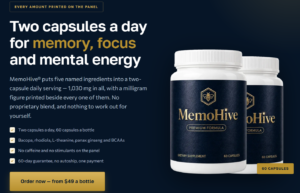
The most detailed MemoHive ingredient information currently available lists five ingredients per two-capsule serving.
The stated formula contains 540 mg of branched-chain amino acids, 200 mg of Bacopa monnieri extract, 100 mg of Rhodiola rosea extract, 100 mg of L-theanine and 90 mg of Panax ginseng extract.
That gives a total listed serving weight of 1,030 mg.
The formula is worth examining individually because not all of these ingredients have the same level of evidence for cognitive benefits.
For consumers wanting to understand how supplement ingredients are regulated and what manufacturers can legally claim, the National Institutes of Health Office of Dietary Supplements provides useful background on dietary supplements and their claims.
MemoHive Review and Bacopa Monnieri
Bacopa monnieri is probably the most interesting ingredient in MemoHive when it comes to memory.
A systematic review published in the Journal of Alternative and Complementary Medicine examined randomized controlled trials of Bacopa in adults. The studies included in the review generally used Bacopa for 12 weeks at doses between 300 and 450 mg per day. The researchers found some evidence of improvement in memory free recall, although evidence for other cognitive areas was more limited.
A separate meta-analysis involving nine randomized controlled trials and 518 participants also found potential improvements in some measures of cognition, particularly attention and processing speed. However, the researchers emphasized the need for larger and better-designed trials using standardized preparations.
More recent research has continued to investigate Bacopa. A 2026 systematic review and network meta-analysis involving 29 randomized trials and 2,107 participants found promising results for Bacopa, particularly at higher doses. However, the authors also noted limitations in the available comparisons.
The important issue for MemoHive is the dose.
The product lists 200 mg of Bacopa per serving, while several earlier clinical studies reviewed in the literature used 300 to 450 mg per day.
That does not automatically mean the MemoHive dose is ineffective. It simply means that the results from those studies cannot be transferred directly to MemoHive without considering the extract, standardization and dosage.
MemoHive Review and Rhodiola Rosea
Rhodiola rosea is commonly used in supplements targeting stress, fatigue and mental performance.
Research into Rhodiola has produced some promising findings, but the evidence is not as straightforward as some supplement advertisements suggest. Studies have investigated Rhodiola for physical and mental fatigue, stress and performance, but differences in extracts, study designs and quality make it difficult to establish one universal effect.
MemoHive lists 100 mg of Rhodiola rosea extract per serving.
The exact extract standardization is therefore important. Simply stating “Rhodiola rosea extract” does not provide enough information to determine whether the preparation matches the one used in a particular clinical trial.
This is a recurring issue with herbal supplements. The plant name alone does not tell the entire story.
MemoHive Review and L-Theanine
L-theanine is an amino acid naturally found in tea and is frequently included in supplements designed around relaxation, attention and mental performance.
The evidence here is interesting but still requires context.
A 2026 systematic review and meta-analysis covering 31 randomized trials with 1,168 participants found that a single 200 mg dose of L-theanine significantly improved choice reaction time in one pooled cognitive outcome. The researchers also reported that the overall evidence varied depending on the outcome being measured.
Another 2025 systematic review and meta-analysis of randomized placebo-controlled trials found that L-theanine could improve certain measures of cognitive performance, but the authors described the evidence as promising rather than completely conclusive.
A recent review of human trials also reported that doses between 100 and 400 mg may produce small improvements in some cognitive outcomes, particularly visual attention, although further research is needed.
MemoHive provides 100 mg of L-theanine per serving.
That dose falls within the range investigated in human studies, but the presence of L-theanine does not prove that the complete MemoHive formula produces the same results.
MemoHive Review and Panax Ginseng
Panax ginseng is another traditional botanical included in the MemoHive formula.
Ginseng has been studied for cognitive performance, mood and physical performance, but the evidence varies considerably depending on the preparation and outcome being examined.
The 90 mg amount listed for MemoHive also makes the exact extract specification important.
Without information about the concentration of active compounds or standardization, comparing the MemoHive product directly with a clinical trial becomes difficult.
This is why a good supplement review should not simply say that an ingredient has been “clinically studied.” The more useful question is whether the ingredient, extract and dose in the actual product resemble the intervention used in those studies.
MemoHive Review and BCAAs
Branched-chain amino acids make up the largest part of the published MemoHive formula at 540 mg per serving.
BCAAs consist of leucine, isoleucine and valine and are commonly associated with sports nutrition and muscle protein metabolism.
Their inclusion does not automatically make MemoHive unsafe or ineffective.
However, it is worth noting that BCAAs are not the primary ingredients responsible for the strongest memory-related research surrounding this formula.
Therefore, the total 1,030 mg serving should not be interpreted as 1,030 mg of proven cognitive ingredients.
MemoHive Review and Conflicting Ingredient Information
This is one of the areas that deserves particular attention.
Different MemoHive-related websites have published different ingredient lists.
One version lists BCAAs, Bacopa monnieri, Rhodiola rosea, L-theanine and Panax ginseng.
Another MemoHive-related website describes a different six-ingredient formulation involving Bacopa, Ginkgo biloba, phosphatidylserine, L-theanine, Rhodiola and vitamin B12.
That discrepancy matters because scientific evidence applies to specific ingredients and doses.
A customer should not have to guess which formula is inside the bottle.
Before purchasing, the actual Supplement Facts panel should be checked carefully. The label on the bottle should match the product page and checkout information.
MemoHive Review and Safety
MemoHive is sold as a dietary supplement rather than a prescription medication.
That distinction is important.
The NIH Office of Dietary Supplements explains that dietary supplements are regulated differently from drugs in the United States. Dietary supplements can carry certain structure-function claims without going through the same premarket approval process required for medicines.
This means that phrases such as “supports memory,” “supports focus” or “promotes cognitive health” should not automatically be interpreted as proof that the product has been clinically proven to produce those outcomes.
People taking prescription medication or managing an existing medical condition should check with a qualified healthcare professional before adding a multi-ingredient supplement.
The same applies during pregnancy or breastfeeding.
Anyone experiencing persistent or worsening memory problems should also seek appropriate medical evaluation instead of assuming that a supplement is the answer.
MemoHive Review and Its Cognitive Claims
MemoHive is promoted around several major benefits including memory support, concentration, mental clarity and cognitive performance.
There is scientific interest behind several of its ingredients.
Bacopa has human evidence involving memory. L-theanine has emerging evidence involving attention and reaction time. Rhodiola has been investigated in relation to fatigue and performance, while ginseng has also been studied for cognitive outcomes.
However, there is an important distinction between ingredient evidence and product evidence.
Research showing that Bacopa may influence certain memory outcomes does not establish that MemoHive will improve memory.
Research showing that L-theanine may affect certain attention measures does not establish that MemoHive will improve concentration in every user.
The complete product would ideally need its own well-designed human clinical trials before stronger claims could be made about its effectiveness.
MemoHive Review and Effectiveness
The evidence surrounding MemoHive is therefore mixed.
There is scientific rationale behind several ingredients, but evidence for the complete formulation remains limited.
Bacopa is supported by several human trials and systematic reviews, although results depend on dosage and preparation.
L-theanine has also accumulated more recent evidence, although researchers continue to describe uncertainty around which cognitive outcomes are most consistently affected.
The problem is that a supplement containing several individually studied ingredients does not automatically inherit the evidence for each ingredient.
That is a common marketing shortcut in the supplement industry.
A product can contain scientifically interesting compounds without the finished product itself being clinically proven.
MemoHive Review and Customer Reviews
Customer reviews can be useful when assessing purchasing experiences, packaging, delivery and whether buyers actually received the product.
They are considerably less useful for establishing whether a supplement improves cognition.
Someone may genuinely report feeling more focused after taking MemoHive. That experience is still anecdotal and cannot establish whether the improvement came from the supplement, expectation, caffeine consumption, improved sleep, dietary changes or normal fluctuations in concentration.
Published testimonials should therefore be considered alongside independent evidence rather than treated as clinical proof.
This is particularly important for cognitive supplements because perceived changes in focus can be difficult to measure without standardized cognitive testing.
MemoHive Review and FDA Claims
Another point worth understanding concerns FDA terminology.
A supplement website may refer to an FDA-registered manufacturing facility or GMP manufacturing.
Those statements should not be interpreted as meaning that the FDA has approved the supplement for improving memory.
According to the NIH Office of Dietary Supplements, dietary supplements are regulated differently from drugs and structure-function claims do not require the same type of FDA premarket approval used for medicines.
For that reason, “FDA registered” and “FDA approved” should never be treated as interchangeable terms.
MemoHive Review and Who Should Be Careful
Extra caution is appropriate for people who are pregnant or breastfeeding, people taking prescription medication, people with chronic medical conditions and anyone experiencing unexplained cognitive changes.
Supplement interactions can depend on the complete ingredient list and the person’s existing medications.
The actual label should therefore be checked rather than relying solely on promotional descriptions.
Anyone experiencing significant or persistent memory problems should also discuss those symptoms with an appropriate healthcare professional.
A supplement should not become a substitute for investigating an underlying medical or nutritional problem.
MemoHive Review and Is It Worth the Hype?
MemoHive contains several ingredients that have legitimate scientific interest.
Bacopa has some of the strongest memory-related evidence among the listed ingredients, while L-theanine has emerging evidence for specific attention outcomes.
However, the evidence does not establish MemoHive itself as a clinically proven memory enhancer.
The inconsistent ingredient information appearing across MemoHive-related websites also gives potential buyers another reason to verify the exact product label before ordering.
The most realistic description of MemoHive is therefore a multi-ingredient cognitive wellness supplement containing several compounds that have been investigated in human research.
That is different from calling it a proven treatment for memory problems.
Anyone considering MemoHive should look beyond the marketing claims, check the exact ingredients and doses, examine the refund terms and compare the formulation with the available scientific evidence.
The bottom line is fairly simple.
Promising ingredients do not automatically equal a proven product.
MemoHive Review Frequently Asked Questions
Is MemoHive proven to improve memory?
The individual ingredients have varying levels of evidence, with Bacopa having human research involving memory outcomes. However, there is not enough independent clinical evidence to describe the complete MemoHive formula as a proven memory treatment.
What are the MemoHive ingredients?
The detailed formula currently published lists BCAAs, Bacopa monnieri, Rhodiola rosea, L-theanine and Panax ginseng. The stated amounts per two-capsule serving are 540 mg, 200 mg, 100 mg, 100 mg and 90 mg respectively.
Does MemoHive contain Ginkgo biloba?
Some MemoHive-related websites have published a different formula that includes Ginkgo biloba, phosphatidylserine and vitamin B12. Because the online ingredient information is inconsistent, the actual Supplement Facts panel on the bottle should be checked before purchase.
Is MemoHive FDA approved?
FDA registration or manufacturing claims should not be interpreted as FDA approval of the supplement. Dietary supplements are regulated differently from drugs in the United States.
How long does MemoHive take to work?
There is no reliable clinical evidence establishing a specific timeframe for the complete MemoHive formula. Research on individual ingredients uses different doses, preparations and treatment periods.
Can MemoHive treat Alzheimer’s disease?
MemoHive should not be treated as a therapy for Alzheimer’s disease or dementia. Evidence for individual ingredients should not be confused with evidence that the finished supplement can treat a neurological disease.
Are MemoHive customer reviews enough to prove that it works?
No. Customer testimonials can describe personal experiences, but they cannot establish clinical effectiveness. Controlled human research provides stronger evidence for determining whether a product actually produces a measurable effect.
Is MemoHive worth buying?
The answer depends on the buyer’s expectations. The formula contains ingredients with legitimate research interest, but the finished product does not currently have enough independent clinical evidence to establish strong claims about memory enhancement. Checking the actual label, dosage, seller information and refund policy is advisable before purchasing.
Final Thoughts on MemoHive Review
MemoHive is an interesting case because the formula contains several ingredients that have been studied for cognitive and mental performance outcomes.
Bacopa has evidence involving memory, while newer research continues to investigate L-theanine and other botanical compounds for attention and cognition.
At the same time, ingredient research should not be mistaken for proof that the finished MemoHive product works exactly as advertised.
The conflicting online ingredient information is another issue that deserves attention.
For potential buyers, the practical approach is to verify the exact Supplement Facts panel, check the dosage, investigate the seller, read the refund conditions and avoid treating testimonials as scientific evidence.
MemoHive may be an interesting supplement to research, but the available evidence supports a more measured interpretation than the strongest marketing claims suggest.
The ingredients deserve investigation. The finished product still needs stronger independent evidence.