
StopWatt Energy Saver Review 2026
If you have seen advertisements promising to cut your electricity bill simply by plugging a small device into a wall socket, you may have come across StopWatt Energy Saver.
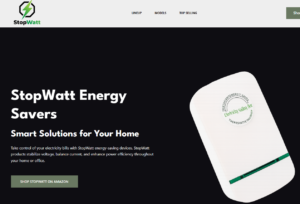
The product is marketed as a plug-in electricity-saving device that supposedly optimizes energy flow, reduces electricity waste, protects household appliances and can lower monthly electricity bills. Its current website claims that users can save up to 45% on electricity costs.
But does StopWatt Energy Saver actually deliver those savings?
This StopWatt Energy Saver review examines the product’s claims, how it is supposed to work, customer complaints, safety considerations, pricing claims and the available evidence surrounding its advertised performance.
The goal is not to simply call the product legitimate or fraudulent. Instead, this review separates the manufacturer’s claims from information that can be independently assessed.
StopWatt Energy Saver Review Summary
Before going into the details, here is the short version.
Product: StopWatt Energy Saver
Product type: Plug-in electrical energy-saving device
Main claim: Reduce household electricity consumption and electricity bills
Advertised maximum saving: Up to 45%
Installation: Plug into a standard outlet
Manufacturer’s stated market: US households
Money-back guarantee advertised: 30 days on the current StopWatt website
Independent evidence supporting 45% savings: Not sufficiently established
Overall assessment: Proceed with caution
The biggest concern is not that the device is advertised as an energy-saving product. It is the size of the claimed savings and whether those savings have been demonstrated through credible, independent testing.
What Is StopWatt Energy Saver Review About?
StopWatt Energy Saver is a compact electrical device designed to remain plugged into a household outlet.
According to the current product website, StopWatt is intended to optimize energy consumption, protect appliances against voltage fluctuations and power surges, and reduce household electricity costs. The seller describes the device as requiring no electrician or complicated installation.
The manufacturer currently promotes savings of up to 45%, although its own FAQ states that actual results can vary according to household usage, appliances and wiring.
That distinction is important.
“Up to 45%” does not mean every household will save 45%. In fact, the seller explicitly says it does not guarantee a particular reduction in an individual electricity bill.
How Does StopWatt Energy Saver Work?
The StopWatt marketing describes the device as monitoring and optimizing energy flow within a home.
Its promotional material refers to energy optimization, voltage stabilization, power quality and protection against electrical fluctuations. The device is presented as something that can operate continuously once plugged into an outlet.
These concepts sound technically plausible because electrical power quality and power factor are legitimate areas of electrical engineering.
However, there is a major difference between a device performing some electrical conditioning function and a device actually reducing the number of kilowatt-hours a household consumes.
That difference is central to evaluating StopWatt.
A household electricity bill is generally connected to measured energy consumption. Therefore, a product claiming to dramatically reduce the bill should ideally demonstrate a measurable reduction in actual energy consumption under controlled conditions.
StopWatt Energy Saver Review of the 45% Savings Claim
The headline claim deserves particularly careful examination.
The current StopWatt website advertises up to 45% savings on electricity bills and elsewhere describes 45% as its average energy-saving figure.
However, a large percentage reduction requires strong evidence.
A consumer should ideally be able to examine independent laboratory testing showing electricity consumption before and after installation, under controlled conditions and using clearly identified equipment.
I could not find sufficiently convincing independent evidence demonstrating that ordinary households should expect a 45% reduction in electricity consumption from StopWatt.
That does not prove that every unit has no electrical effect. It does mean the headline savings figure should not automatically be treated as a typical or independently verified result.
This is an important distinction for anyone searching for a StopWatt Energy Saver review before purchasing.
StopWatt Energy Saver Review and Power Factor
One reason these products can sound convincing is the use of legitimate electrical terminology.
Power factor is a genuine engineering concept. It describes the relationship between real power and apparent power in AC electrical systems.
Power-factor correction is widely used in industrial and commercial environments where electrical equipment such as motors can create significant reactive power demand.
But that does not automatically translate into equivalent savings on a household electricity bill.
For consumers, the important question is not whether power-factor correction exists. It does.
The question is whether the particular StopWatt device can produce a substantial reduction in the actual energy consumption measured by a residential electricity meter.
That claim requires evidence specific to the product.
StopWatt Energy Saver Review of Independent Evidence
Independent evidence is where the StopWatt claims become more difficult to assess.
A June 2026 review investigating StopWatt reported that it could not identify convincing independent evidence supporting the product’s large electricity-saving claims. The same report also discussed complaints concerning refunds, billing and customer service.
There is also consumer complaints listed through the Better Business Bureau. One July 2026 complaint alleged that independent laboratory testing showed the device did not reduce electricity consumption. That statement appears in the complainant’s submission and should therefore be understood as a consumer allegation rather than verified BBB findings.
This distinction matters.
A complaint is not proof that a product is fraudulent. At the same time, a growing pattern of complaints should not simply be ignored when evaluating a product.
The strongest evidence would be reproducible independent laboratory testing rather than testimonials or anonymous online reviews.
StopWatt Energy Saver Review and Customer Complaints
Customer feedback surrounding StopWatt is mixed, but there are reports of dissatisfaction.
The Better Business Bureau currently lists complaints concerning StopWatt, including a July 2026 complaint involving the product’s advertised performance. The BBB page shows that the business responded to that particular complaint.
A separate 2026 investigation reported complaints involving product performance, refunds and customer service.
Customer complaints should be considered supporting information rather than scientific proof.
For example, a reduction in someone’s electricity bill after buying an energy-saving device does not necessarily demonstrate that the device caused the reduction. Electricity consumption can change because of weather, appliance usage, occupancy, working hours and numerous other factors.
Controlled measurements are therefore much more useful than testimonials.
StopWatt Energy Saver Review and Online Marketing
Another reason to exercise caution is the way some StopWatt advertisements have been presented online.
Some promotional pages associated with StopWatt use aggressive discount messaging and urgency-based language. One current sales page advertises a 65% discount and a 60-day guarantee, which differs from the 30-day guarantee stated on another current StopWatt website.
Different websites and promotional pages can exist for legitimate products, but inconsistent claims about discounts and guarantees make it important to identify exactly who is selling the product.
Consumers should check the seller’s domain, refund conditions, final checkout price and customer-service contact information before making payment.
StopWatt Energy Saver Review and Celebrity Endorsement Claims
Consumers should also be cautious about advertisements that associate energy-saving products with famous entrepreneurs, television programmes or celebrities.
A 2026 investigation into StopWatt reported claims involving Elon Musk, Shark Tank and unauthorized endorsements.
A celebrity association does not establish that an electrical product works.
If an advertisement claims that a famous individual endorsed StopWatt, consumers should look for confirmation from the person’s verified website or official social-media account rather than relying on a sales page.
StopWatt Energy Saver Review and Safety
Safety is another important consideration.
The current StopWatt website states that its device is designed for standard US household voltage and standard US outlets.
That specification should not be ignored by international buyers.
Electrical systems differ between countries. A device designed for a US household electrical system should not automatically be connected to a different electrical supply without confirming its voltage, frequency, plug configuration and relevant safety certification.
This is particularly important for buyers in countries that use approximately 220 to 240V household electricity.
More broadly, independent consumer investigations have found that some plug-in products marketed as energy-saving devices have had serious electrical safety problems. A 2025 Which? investigation reported unsafe construction and electrical risks among several products sold as energy-saving plugs.
That investigation did not establish that every StopWatt unit has the same defect. It does, however, demonstrate why consumers should take electrical safety certification seriously.
StopWatt Energy Saver Review Pros
There are some practical features that make the product appealing.
- Compact plug-in design
- Simple installation
- No electrician required according to the seller
- Designed for continuous operation
- Marketed as an appliance protection and energy optimization device
- Money-back guarantee advertised by the seller
The simplicity is probably the product’s biggest selling point.
However, ease of installation should not be confused with proof of energy savings.
StopWatt Energy Saver Review Cons
The limitations are more significant.
- The advertised 45% savings claim lacks sufficient independent verification
- Different sales pages provide different promotional terms
- Consumer complaints have been reported
- Some online marketing has involved disputed endorsement claims
- Voltage compatibility may be an issue for international buyers
- The distinction between power-factor correction and actual household energy savings can be misunderstood
- There is limited publicly available independent testing demonstrating the advertised results
StopWatt Energy Saver Review and Money-Back Guarantee
A refund guarantee can reduce the financial risk associated with trying a product, but it does not prove that the product works.
The current StopWatt website advertises a 30-day money-back guarantee. Another StopWatt sale page currently advertises a 60-day guarantee.
Consumers should therefore read the exact refund policy attached to the website where the purchase is made.
Before paying, check:
- The length of the refund period
- Whether shipping costs are refundable
- Whether return shipping is paid by the customer
- Whether automatic charges can occur
- The correct customer-service email
- The physical return address
- Any conditions attached to refunds
Keeping screenshots of the offer and checkout terms is also sensible when purchasing unfamiliar products online.
StopWatt Energy Saver Review and Better Ways to Save Electricity
For people whose primary goal is reducing electricity consumption, there are approaches with considerably more established practical value.
Energy-efficient lighting, reducing unnecessary standby consumption, maintaining cooling equipment and choosing efficient appliances can directly address energy consumption.
The U.S. Department of Energy provides consumer guidance through its Energy Saver resources, including information about home energy efficiency and ways to reduce electricity use.
Another useful approach is measuring consumption rather than guessing.
An electricity monitor can help identify which appliances consume the most energy. Once the largest loads are known, consumers can focus their efforts where they are most likely to make a measurable difference.
Recent consumer guidance has also highlighted standby electricity use and practical ways of reducing unnecessary consumption.
StopWatt Energy Saver Review and Scam Concerns
Is StopWatt a scam?
That question requires some nuance.
It would be inappropriate to make a definitive legal accusation solely because a product’s claims are questionable or because customers have complained.
A more evidence-based conclusion is that the major energy-saving claims surrounding StopWatt are not sufficiently supported by strong independent evidence to treat the advertised savings as established fact.
The product is being sold, and its current website clearly states what it claims to do.
The concern is whether those claims accurately represent what an average household can realistically achieve.
Consumers should therefore avoid making a purchase decision solely because an advertisement says the device can reduce electricity costs by 40%, 45% or more.
StopWatt Energy Saver Review Final Verdict
After examining the manufacturer’s claims, available consumer complaints and independent discussions, StopWatt Energy Saver deserves a cautious assessment.
The product is attractive because its proposed solution is extremely simple. Plug in a small device and potentially reduce a large electricity bill.
The problem is that the size of the promised savings requires strong evidence.
StopWatt’s current website claims savings of up to 45%, but I could not identify sufficient independent evidence demonstrating that typical households consistently achieve that level of reduction.
There are also documented consumer complaints and independent reports questioning the product’s performance and marketing practices.
Therefore, the most reasonable conclusion is:
StopWatt Energy Saver should be approached with caution. The product’s advertised electricity savings should be considered unverified marketing claims rather than guaranteed household results.
Consumers interested in purchasing should verify the exact model, seller, electrical specifications, safety certification and refund terms before spending money.
For someone primarily interested in lowering an electricity bill, proven energy-efficiency measures and direct monitoring of electricity consumption remain the more evidence-based starting points.
Frequently Asked Questions About StopWatt Energy Saver Review
What Is StopWatt Energy Saver Review Saying About the Product?
This StopWatt Energy Saver review finds that the product is marketed as a plug-in energy-saving and power-optimization device, but its major savings claims are not sufficiently supported by independent evidence.
Does StopWatt Energy Saver Really Save Electricity?
The manufacturer claims that StopWatt can reduce energy consumption by up to 45%. However, there is not enough independent evidence to establish that ordinary households can reliably achieve this level of savings.
Is StopWatt Energy Saver Legit?
StopWatt is being sold as a physical electrical product, but that does not automatically validate its performance claims. Consumers should distinguish between the existence of a product and independent proof that it delivers the advertised savings.
Is StopWatt Energy Saver a Scam?
There are consumer complaints and independent reports questioning its effectiveness and marketing. However, describing the entire product as a scam would be a stronger conclusion than the available evidence supports. The safer conclusion is that buyers should exercise caution.
How Much Can StopWatt Energy Saver Save?
The current manufacturer website claims savings of up to 45%. It also states that actual results vary by household and that a specific bill reduction is not guaranteed.
Does StopWatt Energy Saver Protect Appliances?
The manufacturer claims that StopWatt protects appliances against voltage fluctuations and power surges. Those are manufacturer claims and should not be treated as a substitute for a properly rated surge protector or other electrical protection equipment unless the product’s technical specifications and certification support that use.
Is StopWatt Energy Saver Safe?
Safety depends on the actual construction, electrical specifications and certification of the particular unit. The manufacturer states that the product is intended for standard US household voltage. Buyers should confirm compatibility with their local electrical system before use.
Can StopWatt Energy Saver Be Used Outside the United States?
The current StopWatt website specifically describes the product as designed for standard US household outlets and voltage. International buyers should therefore verify the exact voltage and frequency specifications before purchasing or connecting the device.
What Is the Best Way to Test StopWatt Energy Saver?
A meaningful test would compare measured electricity consumption before and after installation while controlling for appliance usage, weather, occupancy and other variables.
Simply comparing two monthly electricity bills does not prove that StopWatt caused the difference.
Where Can Consumers Find Reliable Energy-Saving Information?
The U.S. Department of Energy provides consumer-focused energy-efficiency information through its Energy Saver programme.
Consumers can also consult their local electricity provider or a qualified electrician for advice specific to their electrical system.