
CeraVe Resurfacing Retinol Face Serum Review
CeraVe Resurfacing Retinol Face Serum is one of those skincare products that has managed to stay popular long after the initial retinol craze started. It is marketed toward people dealing with post-acne marks, uneven skin tone, visible pores and rough texture, while also trying to maintain the skin barrier.
That combination sounds good on paper.
But skincare marketing has a way of making ordinary ingredients sound like they were discovered on Mars.
So, is CeraVe Resurfacing Retinol Face Serum actually worth the hype?
The formula contains encapsulated retinol alongside niacinamide, three essential ceramides, sodium hyaluronate and a licorice-derived ingredient. CeraVe describes the serum as fragrance-free and non-comedogenic and specifically positions it around improving the appearance of post-acne marks, pores and skin texture. You can check the manufacturer’s current CeraVe Resurfacing Retinol Serum product information for the full ingredient list and official claims.
The interesting part is that the product is not simply trying to throw a strong retinoid at your face. It also attempts to support the skin barrier, which could make it a more approachable option for people starting retinol.
Here is what the formula actually offers and what you should realistically expect from it.
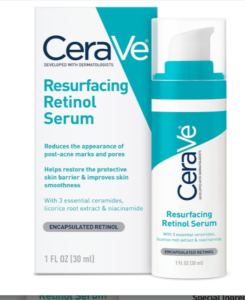
CeraVe Resurfacing Retinol Face Serum Ingredients
The ingredient list provides a pretty good picture of why this serum has developed such a following.
According to CeraVe’s current product information, the formula contains water, propanediol, dimethicone, cetearyl ethylhexanoate, niacinamide, dipotassium glycyrrhizate, ceramide NP, ceramide AP, ceramide EOP, retinol, sodium hyaluronate, cholesterol, phytosphingosine and several supporting ingredients.
The key ingredients deserve a closer look.
CeraVe Resurfacing Retinol Face Serum With Encapsulated Retinol
Retinol is the star of this product.
It is a vitamin A derivative used in skincare to improve the appearance of uneven texture, pigmentation, fine lines and some forms of acne.
CeraVe describes its retinol as encapsulated. The idea behind encapsulation is to protect the ingredient within the formulation and help deliver it gradually.
That matters because retinol can be irritating, especially when someone jumps into daily use too aggressively.
The American Academy of Dermatology’s guidance on retinoids and retinol explains that retinoids can help improve uneven skin tone, pigmentation and signs of skin aging. Dermatologists also use topical retinoids as part of acne treatment.
One important limitation is that CeraVe does not prominently disclose the exact percentage of retinol in this product.
That makes direct strength comparisons with products that advertise concentrations such as 0.3% or 1% difficult.
And honestly, that is something buyers should know before assuming that more expensive automatically means stronger.
CeraVe Resurfacing Retinol Face Serum With Niacinamide
Niacinamide is another major component of the formula.
Also known as vitamin B3, niacinamide is commonly used in skincare for barrier support, hydration and the appearance of uneven tone.
CeraVe says its niacinamide may help calm the skin and support the skin barrier. The ingredient also has a reasonably well-established place in cosmetic dermatology.
Its presence alongside retinol is useful because a retinol routine does not need to become a battle between your face and your skincare cabinet.
CeraVe Resurfacing Retinol Face Serum With Ceramides
This is where CeraVe does what CeraVe does best.
The formula contains ceramide NP, ceramide AP and ceramide EOP.
Ceramides are lipids naturally found within the skin barrier. They help support the barrier and reduce moisture loss.
CeraVe’s explanation of ceramides and the skin barrier provides more detail on why these ingredients appear throughout the brand’s skincare range.
For a retinol serum, this is a sensible formulation strategy.
CeraVe Resurfacing Retinol Face Serum With Sodium Hyaluronate
Sodium hyaluronate is a form of hyaluronic acid.
It functions primarily as a humectant, helping the skin hold onto water.
It is not the ingredient responsible for the resurfacing effect, but it contributes to the hydrating side of the formula.
CeraVe Resurfacing Retinol Face Serum With Licorice-Derived Ingredient
The formula contains dipotassium glycyrrhizate, a licorice-derived ingredient.
Licorice-derived ingredients are frequently used in cosmetic formulations aimed at soothing the skin and improving the appearance of uneven tone.
This makes sense for a product targeting post-acne marks, although it would be inaccurate to describe the ingredient as a miracle pigmentation treatment.
CeraVe Resurfacing Retinol Face Serum Claims
CeraVe positions the serum primarily around post-acne skin.
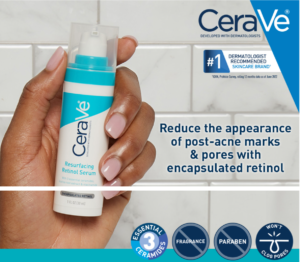
Its stated benefits include reducing the appearance of post-acne marks and pores, improving skin smoothness and helping restore the protective skin barrier.
The manufacturer also describes the formula as non-comedogenic and fragrance-free. The official CeraVe product page is the best place to check the manufacturer’s current claims because formulations and marketing language can change.
CeraVe’s Africa product information reports that in a consumer self-assessment involving 50 participants, 75% agreed that their skin tone looked more even, 83% agreed their skin texture looked smoother and 89% agreed their skin looked healthier.
There is an important distinction here.
These are consumer self-assessment results, not evidence from a large independent clinical trial.
That does not make the findings useless. It simply means they should be interpreted as consumer feedback rather than definitive proof that the product will produce the same results for everyone.
CeraVe Resurfacing Retinol Face Serum Effectiveness
The science behind the main active ingredient is legitimate.
Retinol belongs to the retinoid family, and retinoids have a well-established role in improving acne, pigmentation and skin texture. The American Academy of Dermatology’s acne treatment guidance explains how topical retinoids can help unclog pores and form part of an acne treatment routine.
The question is therefore less about whether retinol works and more about whether this particular formulation works well for a particular person.
For post-acne marks and uneven texture, the product has a reasonable formulation.
But patience is required.
Retinol is not a “use it tonight, wake up flawless tomorrow” ingredient.
Some customers report noticing smoother skin and changes in texture relatively quickly, while pigmentation and other concerns generally require longer and more consistent use.
The AAD’s guidance on acne skincare also emphasizes giving acne treatments time rather than constantly changing products because immediate results are not visible.
CeraVe Resurfacing Retinol Face Serum for Dark Spots
This is probably one of the strongest reasons people buy the serum.
Post-inflammatory hyperpigmentation can remain after acne disappears. These flat dark marks are not necessarily true acne scars, although they are often casually called scars.
The American Academy of Dermatology’s information on acne scars and dark marks explains the difference between acne scarring and pigmentation left behind after inflammation.
Retinoids can help with this type of pigmentation.
However, sunscreen remains extremely important.
UV exposure can worsen pigmentation, and visible light can also contribute to hyperpigmentation, particularly in darker skin tones. The AAD recommends broad-spectrum SPF 30 or higher and discusses the additional role of tinted sunscreen containing iron oxides for visible-light protection.
In other words, buying a retinol serum and skipping sunscreen is basically trying to empty a bathtub while leaving the tap running.
CeraVe Resurfacing Retinol Face Serum for Acne and Pores
The serum can be useful for people concerned about post-acne texture and the appearance of pores.
Retinoids can help prevent clogged pores and are established acne treatments.
However, this product should not be confused with a dedicated acne medication such as adapalene.
CeraVe primarily positions the Resurfacing Retinol Serum around post-acne marks, pores and texture rather than claiming that it will treat every form of active acne.
If someone has persistent, moderate or severe acne, relying entirely on a cosmetic retinol serum may not be enough. The AAD’s acne treatment guide provides a useful overview of the treatment options dermatologists commonly recommend.
CeraVe Resurfacing Retinol Face Serum Safety
Retinol can irritate the skin.
Possible reactions include dryness, redness, peeling, burning or increased sensitivity.
The American Academy of Dermatology’s retinoid guidance recommends introducing retinoids gradually, especially for people who are prone to irritation.
This is particularly important for people with darker skin because significant irritation can potentially trigger or worsen post-inflammatory hyperpigmentation.
CeraVe itself advises starting with a small amount and spacing applications if discomfort occurs. Following the manufacturer’s directions is more sensible than copying somebody’s “seven-day retinol challenge” from TikTok.
The product should be used at night.
CeraVe advises avoiding the eyes and lips and using sunscreen during the day.
There is also alcohol in the ingredient list. Its presence does not automatically mean the product is unsafe, but people with highly reactive or compromised skin should pay attention to how their skin responds.
Retinoids should also be avoided during pregnancy according to the American Academy of Dermatology. Anyone who is pregnant or planning pregnancy should discuss retinoid use with an appropriate healthcare professional.
CeraVe Resurfacing Retinol Face Serum Customer Reviews
Customer feedback is generally positive, but it is not universally glowing.
Retailer feedback can be useful for identifying recurring user experiences, although customer reviews should never be treated as equivalent to clinical research.
For example, Target’s current customer feedback for CeraVe Resurfacing Retinol Serum includes many users discussing smoother-looking skin, texture and acne marks.
Other retailer reviews provide a similar picture.
Some users describe the product as gentle enough for beginners and report improvements in texture, acne marks and pores. Several reviewers also praise the lightweight texture and lack of added fragrance.
There are also customers who did not get the same results.
Some report little visible improvement even after using the serum for several weeks or months. Others report irritation, redness or breakouts.
That variation is not particularly surprising.
Retinol tolerance differs significantly between individuals.
A person who already uses strong retinoids may find this serum too mild, while someone completely new to retinol may find it surprisingly effective.
CeraVe Resurfacing Retinol Face Serum Customer Review Patterns
Looking across current retailer feedback, several themes appear repeatedly.
Positive experiences include
- Smoother skin texture
- Less noticeable pores
- Gradual fading of acne marks
- Lightweight application
- Little or no fragrance
- Beginner-friendly retinol experience
- Less irritation than some stronger retinol products
Negative experiences include
- Slow results
- Irritation or redness
- Breakouts during the adjustment period
- Not enough improvement for experienced retinol users
- Perceived high price compared with alternatives
The important thing is not to cherry-pick either side.
A handful of five-star reviews does not prove that the serum works for everyone. A handful of one-star reviews does not prove that the product is bad.
Look for patterns across a large number of verified customer experiences and compare those experiences with what the ingredient evidence actually supports.
CeraVe Resurfacing Retinol Face Serum Pros and Cons
CeraVe Resurfacing Retinol Face Serum Pros
- Contains encapsulated retinol
- Contains niacinamide
- Contains three essential ceramides
- Contains sodium hyaluronate
- Fragrance-free
- Non-comedogenic
- Lightweight texture
- Designed specifically for post-acne skin
- Can improve the appearance of uneven texture and pigmentation
- Suitable for people looking for a gentler introduction to retinol
CeraVe Resurfacing Retinol Face Serum Cons
- Exact retinol concentration is not disclosed
- Results can be gradual
- Can still cause irritation
- Not suitable for everyone
- May be too mild for experienced retinoid users
- Does not replace professional treatment for severe acne or scarring
- Requires consistent sunscreen use
- Some users may experience an adjustment period
CeraVe Resurfacing Retinol Face Serum Worth the Hype
This is where things get interesting.
CeraVe Resurfacing Retinol Face Serum is not fake hype.
There is a legitimate active ingredient in the formula, and retinol has a substantial dermatological evidence base for improving acne, pigmentation and skin texture.
The supporting ingredients are also sensible.
Niacinamide, ceramides, sodium hyaluronate and the licorice-derived ingredient give the formula more than just a retinol-and-pray approach.
But the product is not a miracle worker.
The undisclosed retinol concentration also means consumers cannot easily determine how strong it is compared with competing retinol treatments.
For beginners, that may not be a dealbreaker.
In fact, a relatively gentle retinol that someone can tolerate consistently may be more useful than a stronger product that leaves their skin irritated and abandoned in a bathroom drawer.
For experienced retinoid users looking for maximum strength, however, this may not be enough.
CeraVe Resurfacing Retinol Face Serum Final Verdict
CeraVe Resurfacing Retinol Face Serum is a legitimate skincare product with a sensible formulation and a clear target audience.
Its biggest strengths are the combination of encapsulated retinol, niacinamide and barrier-supporting ceramides, along with its fragrance-free and non-comedogenic positioning.
Its biggest weakness is the lack of a disclosed retinol concentration, which makes it harder to judge potency.
The customer feedback is mostly favorable, particularly among beginners and people looking for gradual improvements in texture and post-acne marks. However, reports of irritation and disappointing results show that it is not universally suitable.
So, is CeraVe Resurfacing Retinol Face Serum worth the hype?
For someone looking for a relatively approachable retinol serum for post-acne marks, uneven texture and visible pores, the formula has a reasonable case. For someone expecting instant pigmentation removal or a high-strength retinoid treatment, expectations should be considerably lower.
The real value here is consistency.
Retinol does not need to make your face peel like a snake to be doing something.
CeraVe Resurfacing Retinol Face Serum Frequently Asked Questions
Is CeraVe Resurfacing Retinol Face Serum good for acne marks?
It can help improve the appearance of post-acne marks because retinol can promote skin turnover and help fade pigmentation left after acne. CeraVe specifically markets this serum for post-acne marks.
Does CeraVe Resurfacing Retinol Face Serum remove dark spots?
It can help fade some types of post-inflammatory hyperpigmentation over time, but it will not instantly erase dark spots. Consistent sunscreen use is important because UV and visible light exposure can worsen pigmentation.
Can CeraVe Resurfacing Retinol Face Serum treat active acne?
Retinoids can help with acne and clogged pores, but this specific serum is primarily positioned around post-acne marks, pores and texture. People with persistent or moderate-to-severe acne may need a more targeted acne treatment.
Is CeraVe Resurfacing Retinol Face Serum suitable for beginners?
It can be a reasonable beginner option because the formula combines encapsulated retinol with barrier-supporting ingredients. However, beginners should still introduce it slowly rather than immediately applying it every night.
Can CeraVe Resurfacing Retinol Face Serum cause purging?
Retinoids can cause an adjustment period in some users. However, not every breakout after starting retinol should automatically be called purging. Persistent burning, severe redness or worsening irritation is a different matter and may indicate that the skin is not tolerating the product.
Can CeraVe Resurfacing Retinol Face Serum damage the skin barrier?
Retinol can cause irritation when overused. The formula contains ceramides and niacinamide to support the skin barrier, but these ingredients do not make the product irritation-proof.
Can CeraVe Resurfacing Retinol Face Serum be used every night?
It may eventually be tolerated nightly by some users, but beginners should not assume that nightly application is necessary from day one. Gradually increasing frequency based on tolerance is a more cautious approach.
Should you use sunscreen with CeraVe Resurfacing Retinol Face Serum?
Yes. CeraVe recommends sunscreen while using the product, and dermatologists recommend sun protection as part of a retinoid skincare routine.
Does CeraVe Resurfacing Retinol Face Serum contain fragrance?
CeraVe describes the product as fragrance-free.
What is the retinol percentage in CeraVe Resurfacing Retinol Face Serum?
CeraVe’s current official ingredient information lists retinol but does not state a percentage. Therefore, claims assigning a precise retinol concentration should be treated cautiously unless they can be verified directly from the manufacturer.
Is CeraVe Resurfacing Retinol Face Serum worth buying?
It can make sense for consumers looking for a retinol product aimed at post-acne marks, uneven texture and visible pores, particularly those who prefer a formula that also contains barrier-supporting ingredients. However, consumers wanting a clearly disclosed high-strength retinol may prefer a product that publishes its concentration.
CeraVe Resurfacing Retinol Face Serum Buyer Checklist
Before buying, check the following.
Your main concern
Post-acne marks, uneven texture and visible pores are the concerns this product is specifically designed around.
Your retinol experience
If you are completely new to retinol, introduce it slowly.
Your skin barrier
If your skin is already irritated, peeling or severely dry, adding retinol may make things worse.
Your sunscreen routine
If you are not willing to use sunscreen consistently, reconsider adding a retinol product to your routine.
Your expectations
Think gradual improvement rather than overnight transformation.
Your source
Buy from an authorized or reputable retailer where possible. When buying through Amazon, check the seller information, packaging and product details rather than assuming every listing comes directly from CeraVe.
CeraVe Resurfacing Retinol Face Serum Summary
CeraVe Resurfacing Retinol Face Serum has earned its popularity for a fairly straightforward reason. It combines a scientifically established skincare active with several barrier-supporting ingredients in a formula aimed at post-acne skin.
It is not perfect.
The retinol concentration is not disclosed, results can take time and irritation remains possible.
But the formula is not relying on hype alone.
For the right user, it can be a practical addition to a nighttime skincare routine. For everyone else, particularly those expecting dramatic overnight results, the marketing deserves to be viewed with a healthy dose of skepticism.