
TruSkin Vitamin C Serum Review
Vitamin C serums have become one of those skincare products that seem almost impossible to escape. Every other product promises brighter skin, fewer dark spots, smoother texture and a younger-looking complexion. The problem is that having vitamin C somewhere on an ingredient list does not automatically make a serum effective.
The TruSkin Vitamin C Serum is one of the more recognizable vitamin C serums on Amazon, particularly among shoppers looking for a brightening product that also contains hyaluronic acid, vitamin E and botanical ingredients.
The formula is marketed toward dull skin, uneven tone and dark spots, while also making broader antioxidant and anti-aging claims.
But there is an important question here.
Does TruSkin Vitamin C Serum actually deserve the hype, or is it simply another heavily marketed skincare product with a good-looking ingredient list?
A close look at the formulation, individual ingredients, manufacturer claims, available scientific evidence and customer feedback to separate what looks promising from what deserves a little more skepticism.
TruSkin Vitamin C Serum Ingredients
The ingredient list published by TruSkin includes water, organic aloe vera leaf juice, Sodium Ascorbyl Phosphate, witch hazel water, MSM, Cassia Angustifolia seed polysaccharide, vitamin E, glycerin, carbomer, arginine, Centella Asiatica, horsetail extract, dandelion extract, sodium hyaluronate, geranium extract, jojoba seed oil, phenoxyethanol, ethylhexylglycerin and sodium hydroxide.
The interesting part is that this is not a straightforward high-strength L-ascorbic acid serum.
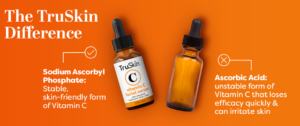
TruSkin uses Sodium Ascorbyl Phosphate, commonly abbreviated as SAP, as its vitamin C ingredient.
That distinction matters.
TruSkin Vitamin C Serum and Sodium Ascorbyl Phosphate
Sodium Ascorbyl Phosphate is a vitamin C derivative rather than pure L-ascorbic acid.
One reason formulators use vitamin C derivatives is stability. Pure L-ascorbic acid can be challenging to formulate because it is sensitive to oxidation and formulation conditions.
The trade-off is that vitamin C derivatives do not necessarily have the same amount of clinical evidence or skin penetration data as L-ascorbic acid.
A 2026 systematic review published in PubMed examined vitamin C applications in dermatology and noted that clinical effectiveness depends heavily on the specific vitamin C derivative, vehicle, pH, stabilization strategy and delivery method. The review also identified L-ascorbic acid as the most clinically validated topical form while noting that derivatives can offer stability advantages.
That does not mean SAP is useless.
It is a legitimate vitamin C derivative with a different evidence profile.
TruSkin Vitamin C Serum and Hyaluronic Acid
The product also contains sodium hyaluronate, which is a salt form of hyaluronic acid.
It is mainly included for hydration rather than pigmentation.
Hyaluronic acid can attract and retain water in the skin, which can temporarily make the skin appear smoother and more plump.
According to the American Academy of Dermatology’s information on skin care ingredients, humectant ingredients can help draw water into the skin and are commonly used in moisturizers and hydrating skincare products.
TruSkin also includes Cassia Angustifolia seed polysaccharide, which the company describes as a botanical hyaluronic acid alternative.
This combination makes sense for a serum marketed toward dull and dehydrated-looking skin.
However, it is important not to confuse hydration with permanent anti-aging.
A hydrated face can look smoother and healthier without the product actually removing wrinkles.
TruSkin Vitamin C Serum and Vitamin E
The formula also contains tocopheryl acetate, a form of vitamin E.
Vitamin C and vitamin E are both antioxidants, and scientific literature has explored their complementary roles in protecting skin from oxidative stress.
A review published in the Indian Journal of Clinical Biochemistry and indexed by PubMed discusses topical vitamin C’s antioxidant activity and its potential applications in pigmentation, collagen synthesis and photoaging.
The combination therefore makes biological sense.
That said, having vitamin E in the bottle does not automatically make the product dramatically more effective.
Concentration, stability, formulation and delivery all matter.
TruSkin Vitamin C Serum and Aloe Vera
Aloe vera is one of the first ingredients listed after water.
That suggests the formula is not simply built around an aggressive active ingredient. Aloe is commonly used in skincare formulations for its moisturizing and soothing properties.
For people who find stronger acidic vitamin C products irritating, a formulation built around a vitamin C derivative may be more appealing.
However, “gentler” does not mean “irritation-proof.”
Every skin type is different.
TruSkin Vitamin C Serum and Witch Hazel
This is one ingredient I would pay more attention to if you have sensitive skin.
Witch hazel is commonly used in skincare because of its astringent properties. Some people like the cleaner feeling it gives the skin, while others may experience dryness or irritation.
It is therefore difficult to call this formula universally suitable for sensitive skin simply because it uses a vitamin C derivative.
If your skin barrier is already irritated, introducing a new active serum should be done cautiously.
TruSkin Vitamin C Serum and Botanical Extracts
The formula contains Centella Asiatica, horsetail, dandelion and geranium extracts.
Centella Asiatica is probably the most interesting of these from a skincare perspective because it has been investigated for its potential role in supporting skin repair and soothing inflammatory processes.
But this is where skincare marketing can get a little carried away.
A product containing several botanical extracts is not automatically more effective than a simpler formula.
The main active story here remains the vitamin C derivative, supported by hydrating and antioxidant ingredients.
TruSkin Vitamin C Serum Claims
TruSkin positions the serum around concerns including uneven tone, dark spots and dull skin. The company recommends using 3 to 5 drops on clean skin, followed by moisturizer and sunscreen. It also recommends patch testing for 24 to 48 hours before applying the product more widely. These directions can be checked directly on the official TruSkin product page.
The broader claims associated with topical vitamin C include antioxidant protection, support for collagen production and improvement in hyperpigmentation and photoaging.
There is scientific evidence supporting several of these mechanisms.
A 2023 systematic review indexed by PubMed examined randomized controlled studies of topical vitamin C for melasma and photoaging. The review found improvements in pigmentation and some measures of skin smoothness and wrinkles, although it emphasized that noticeable results may require long-term use and that more research is needed to determine the optimal concentration and formulation.
That is an important reality check.
The research supports topical vitamin C as an ingredient category.
It does not prove that every vitamin C serum will produce the same results.
TruSkin Vitamin C Serum for Dark Spots
This is probably one of the main reasons shoppers consider this product.
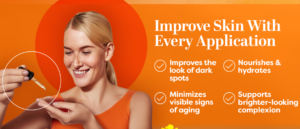
Vitamin C can interfere with pathways involved in melanin production and can help reduce the appearance of uneven pigmentation.
Research has found that topical vitamin C has antipigmenting properties, although the evidence is more complicated than the typical “erase dark spots” marketing language suggests.
The 2023 PubMed systematic review on topical vitamin C found evidence of improvements in pigmentation in several clinical studies, but the researchers also emphasized that treatment duration and formulation can influence results.
So yes, TruSkin Vitamin C Serum may help with mild pigmentation.
No, I would not expect it to erase stubborn dark marks within a few days.
TruSkin Vitamin C Serum for Acne Marks
There is an important distinction between acne marks and acne scars.
If you are dealing with post-inflammatory hyperpigmentation, meaning the brown or dark marks left behind after acne, a vitamin C serum may be useful as part of a broader brightening routine.
If you have actual indented or raised acne scars, however, a topical vitamin C serum is not going to magically remodel scar tissue.
That is a completely different problem.
For pigmentation, sunscreen also matters enormously. Continuing to expose pigmented skin to UV radiation while trying to fade it with skincare is basically fighting yourself.
The American Academy of Dermatology’s guidance on hyperpigmentation also emphasizes sun protection as an important part of managing pigmentation.
TruSkin Vitamin C Serum for Wrinkles
Vitamin C has a legitimate anti-aging argument behind it.
It participates in biological processes involved in collagen synthesis and has antioxidant properties that may help counter oxidative stress associated with photoaging. The scientific background is discussed in detail in this PubMed review of topical vitamin C and the skin.
Clinical studies have also reported improvements in aspects of photoaged skin after consistent topical vitamin C use.
However, evidence on wrinkle reduction is not completely definitive.
A systematic review of topical vitamin C for skin aging found evidence suggesting benefits for some photoaging outcomes while also highlighting the need for better-quality comparative research.
So I would put TruSkin in the category of potentially useful long-term antioxidant and anti-aging skincare, not “Botox in a bottle.”
TruSkin Vitamin C Serum Safety
The product is intended for external use, and TruSkin specifically recommends performing a patch test before applying it to the entire face.
That recommendation is worth following.
Potential issues are not limited to the vitamin C itself. Botanical extracts, witch hazel and preservatives can also cause irritation or sensitivity in some individuals.
Possible reactions can include redness, burning, itching, dryness or irritation.
If your skin is already compromised, introducing several new products at once makes it difficult to identify the culprit if something goes wrong.
A smarter approach is to introduce one new active at a time.
TruSkin Vitamin C Serum and Sensitive Skin
The use of Sodium Ascorbyl Phosphate may make this formula appealing to people who do not tolerate stronger L-ascorbic acid serums.
But I would not automatically classify it as a sensitive-skin product.
The formula contains witch hazel and multiple botanical extracts, which some people may tolerate perfectly well and others may not.
If your skin is reactive, patch testing is the bare minimum.
Start slowly rather than applying a large amount every morning and hoping your skin cooperates.
TruSkin Vitamin C Serum Effectiveness
The biggest question is whether the product works beyond the ingredient list.
The answer is more nuanced than a simple yes or no.
There is reasonable scientific evidence supporting topical vitamin C for pigmentation and photoaging. A 2023 systematic review in PubMed found evidence of improved pigmentation and skin texture, while also noting that long-term use may be necessary.
A more recent 2026 review of vitamin C in dermatology similarly found that vitamin C effectiveness varies according to the particular derivative and formulation.
That means the ingredient itself has scientific credibility.
The limitation is that there is not equivalent clinical evidence proving that this exact TruSkin formulation will produce the same magnitude of improvement seen in every vitamin C study.
That distinction is often missing from skincare advertising.
TruSkin Vitamin C Serum Customer Reviews
Customer feedback is useful for identifying common experiences, but it should not be treated like a clinical trial.
The product has accumulated a large customer following on Amazon, with reviews commonly mentioning brighter-looking skin, smoother texture, hydration and improvements in the appearance of dark spots.
Other users report little visible change or irritation.
That variation actually makes sense.
Skincare results are affected by pigmentation type, baseline skin condition, consistency, sunscreen use, other active ingredients and individual sensitivity.
One person seeing a dramatic improvement does not establish that the product will work identically for everyone.
Likewise, one negative review does not prove that the formula is ineffective.
The useful takeaway from customer feedback is that the product appears to work well for some people while producing more modest results for others.
TruSkin Vitamin C Serum Pros and Cons
TruSkin Vitamin C Serum Pros
- Contains Sodium Ascorbyl Phosphate as the vitamin C derivative
- Includes sodium hyaluronate for hydration
- Contains vitamin E
- Contains aloe vera
- Includes Centella Asiatica and other botanical extracts
- Designed around dullness and uneven skin tone
- May be easier to tolerate than some highly acidic vitamin C formulas
- Can be incorporated into a morning skincare routine
- Has substantial consumer feedback behind it
TruSkin Vitamin C Serum Cons
- The concentration of Sodium Ascorbyl Phosphate is not prominently disclosed
- SAP does not have the same clinical evidence base as L-ascorbic acid
- Witch hazel may not suit everyone
- Multiple botanical ingredients create additional possibilities for irritation
- Results are unlikely to be immediate
- It will not remove structural acne scars
- It should not be treated as a substitute for sunscreen
- Marketing claims should not be confused with clinical evidence for this exact formulation
TruSkin Vitamin C Serum How to Use It
TruSkin recommends applying 3 to 5 drops to clean skin and allowing the serum to absorb before applying moisturizer and sunscreen. The company says the serum can be used on the face, neck and backs of the hands once or twice daily.
A simple routine would look like this.
Morning
Cleanser
TruSkin Vitamin C Serum
Moisturizer
Broad-spectrum sunscreen
If you are new to vitamin C, starting every other day is a reasonable way to assess tolerance.
There is also no need to drown your face in serum.
More product does not automatically equal better results.
TruSkin Vitamin C Serum and Sunscreen
This deserves its own section because it is one of the easiest things to get wrong.
Vitamin C does not replace sunscreen.
The scientific literature supports vitamin C as an antioxidant and antipigmenting ingredient, but UV exposure remains a major driver of photoaging and pigmentation. The American Academy of Dermatology’s sunscreen guidance recommends broad-spectrum sunscreen as part of sun protection.
If your goal is to improve dark spots or prevent further sun-related damage, sunscreen should remain a major part of the routine.
Think of the vitamin C serum as support.
Not body armor.
TruSkin Vitamin C Serum Compared With L-Ascorbic Acid
This is where shoppers need to understand what they are buying.
L-ascorbic acid is the traditional form of topical vitamin C with the strongest clinical validation.
Sodium Ascorbyl Phosphate is a derivative.
The advantage is formulation stability and potentially better tolerability.
The trade-off is that the evidence base and skin delivery characteristics are different.
The 2026 systematic review of vitamin C in dermatology concluded that formulation chemistry, stability, vehicle and delivery all influence clinical performance.
Therefore, someone looking specifically for a high-strength L-ascorbic acid treatment may prefer a different serum.
Someone looking for a more approachable vitamin C derivative with hydrating ingredients may find TruSkin more appealing.
Neither choice automatically makes the other product bad.
TruSkin Vitamin C Serum Is It Worth the Hype?
This is where I would separate worth considering from overhyped.
TruSkin Vitamin C Serum has a legitimate active ingredient, a reasonable supporting formula and a scientific rationale behind topical vitamin C.
The product is not built around some mystery ingredient with no dermatological relevance.
At the same time, the product should not be treated as a miracle treatment for every pigmentation or aging concern.
The biggest limitation is that the exact concentration of Sodium Ascorbyl Phosphate is not prominently disclosed, which makes it harder to compare the formula directly with products that publish their active concentration.
The clinical literature also tells us that vitamin C results depend heavily on formulation and delivery rather than simply the presence of vitamin C on the ingredient list.
So, is TruSkin Vitamin C Serum worth buying?
For someone looking for a vitamin C derivative combined with hydrating and antioxidant ingredients, TruSkin Vitamin C Serum is a reasonable product to consider.
For someone expecting rapid removal of dark spots, dramatic wrinkle reduction or complete acne-scar removal, the expectations are too high.
The product’s strongest case is gradual brightening, antioxidant support and improvement in the overall appearance of uneven skin.
Its weakest case is the idea that it can transform the skin overnight.
It cannot.
TruSkin Vitamin C Serum Final Verdict
After looking beyond the Amazon hype and the marketing language, TruSkin Vitamin C Serum sits somewhere in the middle.
It has a legitimate formulation concept.
It contains Sodium Ascorbyl Phosphate, sodium hyaluronate, vitamin E, aloe vera and several botanical ingredients. The vitamin C component has a reasonable scientific basis for antioxidant activity, pigmentation support and aspects of photoaging.
But there is a difference between having scientifically supported ingredients and having strong clinical evidence for the finished product.
That distinction is important.
I would not call TruSkin Vitamin C Serum a scam or a useless skincare product.
I also would not call it a miracle serum.
For mild dullness, uneven tone and general antioxidant skincare, it is a sensible option.
For stubborn melasma, severe hyperpigmentation, deep acne scars or advanced photoaging, you may need a more targeted approach.
The overall takeaway is simple. TruSkin Vitamin C Serum appears to be a legitimate vitamin C skincare product with a reasonable formulation, but the hype should remain proportional to the evidence.
If you use it consistently, introduce it carefully and pair it with sunscreen, you are giving the formula a fair chance to work.
Just do not expect a bottle of serum to perform dermatological surgery.
Frequently Asked Questions About TruSkin Vitamin C Serum
Is TruSkin Vitamin C Serum good for dark spots?
It may help improve the appearance of uneven pigmentation over time. Research supports topical vitamin C as an antipigmenting ingredient, although results can take time and vary between formulations.
Does TruSkin Vitamin C Serum contain real vitamin C?
Yes. The formula contains Sodium Ascorbyl Phosphate, which is a vitamin C derivative.
Does TruSkin Vitamin C Serum contain hyaluronic acid?
Yes. It contains sodium hyaluronate, a form of hyaluronic acid, as well as Cassia Angustifolia seed polysaccharide, which TruSkin describes as a botanical hyaluronic acid alternative.
Can TruSkin Vitamin C Serum remove acne scars?
It may help with the appearance of dark marks left after acne, particularly post-inflammatory hyperpigmentation. It should not be expected to remove indented or raised acne scars.
Can TruSkin Vitamin C Serum reduce wrinkles?
Topical vitamin C has evidence supporting improvements in some photoaging and wrinkle-related measures. However, results generally require consistent use over time, and evidence for any specific commercial serum is more limited.
Can TruSkin Vitamin C Serum irritate the skin?
Yes. Even though Sodium Ascorbyl Phosphate can be a more approachable vitamin C option than strong acidic formulations, the product also contains witch hazel and botanical extracts that may not suit every skin type.
Can you use TruSkin Vitamin C Serum every day?
TruSkin states that the serum can be used once or twice daily. If you are new to vitamin C or have sensitive skin, introducing it gradually may be more sensible.
Should you use sunscreen with TruSkin Vitamin C Serum?
Absolutely. Vitamin C does not replace sunscreen. Sunscreen remains essential for reducing UV-related photoaging and helping prevent pigmentation from becoming worse.
Is TruSkin Vitamin C Serum worth the hype?
It has enough legitimate ingredients and scientific rationale to be worth considering, but the product should not be treated as a miracle treatment. Its likely benefits are better framed as gradual brightening, antioxidant support and improvement in the appearance of uneven skin rather than dramatic overnight transformation.
Where can you buy TruSkin Vitamin C Serum?
The product is available through the Amazon listing supplied for this review. The manufacturer’s current formulation and usage information can also be checked on the official TruSkin website.
Buyer Checklist for TruSkin Vitamin C Serum
Before buying, consider these points.
- Check the current ingredient list because cosmetic formulations can change.
- Do not assume the serum contains a high percentage of vitamin C simply because vitamin C is listed prominently.
- Consider whether Sodium Ascorbyl Phosphate suits your skincare goals.
- Patch test before applying it across your entire face.
- Use sunscreen consistently if pigmentation is your main concern.
- Give brightening products enough time to work rather than judging them after several applications.
- Do not expect a topical serum to remove deep acne scars.
- If you have persistent or worsening pigmentation, consider speaking with a dermatologist rather than continuously adding more products.
Related Scam Alerts and Review
- Medicube PDRN Pink Peptide Serum Review 2026
- EQQUALBERRY Vitamin Illuminating Serum Review 2026
- CeraVe Resurfacing Retinol Face Serum Review 2026